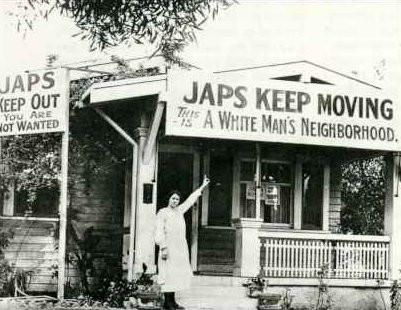
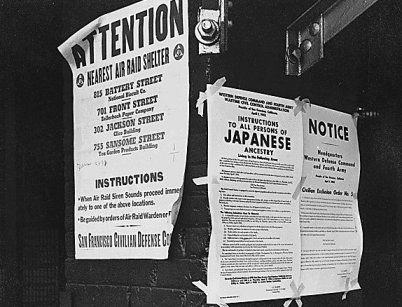
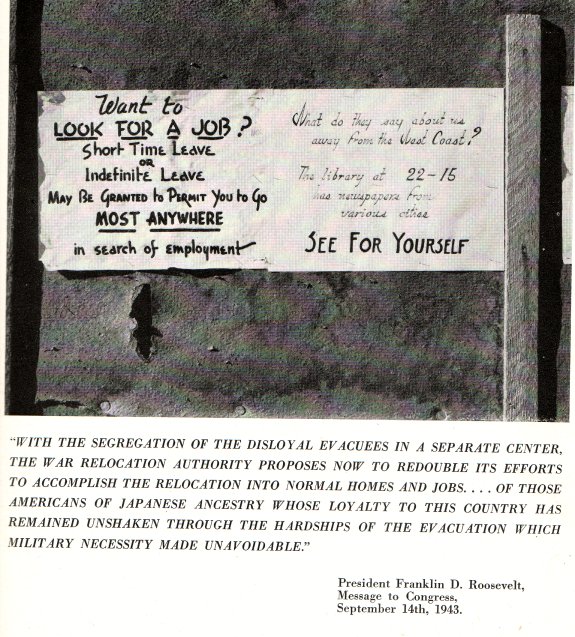
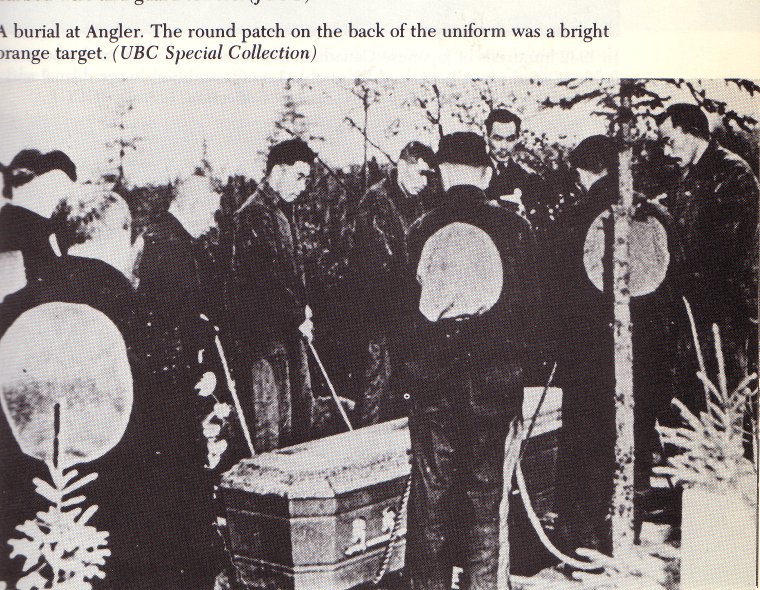
A historical fact that is not really "common knowledge" is the fact that, during World War II, over 100,000 Japanese-American individuals, the vast majority of which were actually American citizens, were rounded up and shipped eventually to internment camps. These consisted of poorly-constructed barracks surrounded by barbed wire, sentry posts and armed guards.
They were put in these camps, not because they had been tried and found guilty of something, but because either they or their parents or ancestors were from Japan and, as such, they were deemed a "threat" to national security. They were also easily identifiable due to their race. There was no similar large-scale roundups of German or Italian-Americans, even though we were also fighting them during World War II.
These people were forced to abandon their businesses, their homes and, in many cases, their families as some individuals were taken elsewhere and held, again without trial, for years. The Japanese-Americans suffered severe economic losses, personal humiliation and, in a some cases, death, due to this relocation.
The relocation itself was ordered by the then President of the United States, Franklin D. Roosevelt, and by an act of Congress.
The Japanese-American (Nisei) and the Japanese aliens (Issei) on the West Coast were rounded up and moved to assembly centers and then to internment camps. Few Japanese living in the East or Midwestern portions of the U.S., though, were treated the same way.
What is extremely interesting is that the Nisei and Issei living in Hawaii were not subject to a mass evacuation even though they formed a third of the population in Hawaii and were a lot closer to Japan than the Japanese-Americans on the West Coast of the U.S.
The reasons they weren't rounded up were both cultural and economic.
"There was no mass relocation and internment in Hawaii, where the population was one-third Japanese American. It would have been impossible to transport that many people to the mainland, and the Hawaiian economy would have collapsed without Japanese American workers. "
-from the book Japanese American Internment Camps by Gail Sakurai, 2002
"Ironically, the territory with the largest Japanese population saw the least discrimination. More than one third of all residents of Hawaii had some Japanese ancestry. Japanese labor was considered vital to the civilian and military economics of the Hawaiian Islands. Besides, the views of Delos Emmons, military commander of Hawaii, were the opposite of those of General DeWitt."
-from the book Japanese-American internment in American History, 1996.
As noted in some of the other reviews, there were a very small number of people arrested and detained in Hawaii and a small number that voluntarily went to the mainland camps, but primarily so they could find relatives. There was not a single act of sabotage in Hawaii by the Japanese Americans during the entire war.
In addition, since there were so many people of Japanese ancestry already living in Hawaii, about a third of the population, racism was not at all the kind of problem it was on the west coast.
Although prejudice and discrimination played major roles in the internment, economics and jealousy did also, as many Californians were jealous of the economic success that the Japanese-American farmers and store owners enjoyed. Thus arose a lot of the anti-Japanese-American feeling in the same way that some people despise Jewish people, largely due to their economic successes. The hard work, self-sacrifice, and strong efforts by the Japanese-Americans and Jewish people are overlooked and ignored when people of prejudice proclaim their judgments against Japanese-Americans and Jewish people.
The fact that the internment did happen here in the U.S. is something to never forget since what has happened once could very well happen again, especially in these days of growing anti-immigrant, anti-foreigner feelings in the U.S.
In the following book reviews I use certain terms without defining them every single time. These include the following:
Issei: people born in Japan who moved to the U.S. and settled here
Nisei: children born to the Issei, they were automatically U.S. citizens
Sansei: the children born to the Nisei
Kibei: People of Japanese ancestry born in the U.S. but returned to Japan to get their education, then came back to the U.S.
JACL: Japanese American Citizens League, a major, although controversial, national organization for Japanese Americans
Redress movement: the movement to get the government to apologize for what it did by interning the Japanese Americans and to provide the survivors with some form of monetary compensation
Assembly Center: Where people were initially held during the "relocation" process
Internment Camp: One of ten camps in various states where people were moved to from the Assembly Centers. Some sources use the term "concentration camp" instead of "internment camp."
PJA: Persons of Japanese Ancestry
Reviews of articles, books and movies
This section is going to consist of reviews of a number of things. Included will be reviews and summaries of books.There will also be reviews and summaries of various documents such as Proceedings of the Asiatic Exclusion League, and various others that relate to pre-war prejudice against the Japanese Americans, and the actual internment of persons of Japanese ancestry during the war. There are over two hundred reviews in this section.
Note: Please do not ask me where individual photos came from. I got photos from a large variety of sites and do not have a list of where specific photos came from. The National Archives is a good place to look for photos.
Assembly Inn, Montreat, North Carolina
Bedford Springs Hotel, Bedford, Pennsylvania
Cascade Inn/The Homestead, Hot Springs, West Virginia (holding Japanese diplomats)
The Greenbrier Hotel, White Sulphur Springs, West Virginia (holding diplomats)
Grove Park Inn, Asheville,North Carolina
Shenvalee Hotel, New Market, Virginia
Temporary Detention Facilities
These were leased or loaned from other Federal agencies and were used to hold enemy aliens on a temporary basis. They include: Chicago (4800 Ellis Ave.); Pittsburgh (Penn Armory); Nanticoke, PA (State Armory); Tampa Florida (specific place?); Miami Florida (Stadium); Syracuse, NY (former fire station); Niagara Falls (former immigrant station); Cleveland (former police station); Houston (former police station); Cincinnati (Post Office building); Milwaukee (House of Correction); Kansas City (Municipal building); Salt Lake City (county jail space); St. Louis (county jail space); Portland (county jail space); St. Paul (county jail space); Hartford CT. (Community Center building) and Los Angeles (Terminal Island).
There are certain topics that I think are very important, and that I scanned items from the newsletters about. These include things like crime, the control of Japanese literature, legal matters, maps, protests and strikes, repatriation, rumors and violence. The main index page for those is here
Books I've Done on these topics
I have picked three topics dealing with the internment camps to do ebooks on. These are available on Amazon.com. The titles are:
From the Inside: Maps, Illustrations and Photos used in internment camp newsletters
From the Inside:Articles relating to violence as taken from the internment camp newsletters.
From the Inside:Articles relating to prejudice as taken from internment camp newsletters.
Links
My thanks to Wes for the first link. Anyone finding other links that would be of good quality and relevent, please let me know and I'll add them here.
1. CBC Archives
Relocation to Redress: The Internment of the Japanese Canadians. Covers Hiroshima, the internment of persons of Japanese ancestry, Canadian women in the Second World War, etc.
2. Densho. Densho's mission is to preserve the testimonies of Japanese Americans who were unjustly incarcerated during World War II before their memories are extinguished. We offer these irreplaceable firsthand accounts, coupled with historical images and teacher resources, to explore principles of democracy and promote equal justice for all.
This is something I didn't find any references to in the books. Apparently a couple of internee sisters helped some German prisoners of war to escape and were caught and then put on trial for treason. (The Oakland Tribune, Aug. 6, 1944). The article points out they are Nisei, which means they are American citizens and thus could be tried for treason.A rather unusual case of civilian aid to escaping German prisoners occurred the following month in Colorado. Two Afrika Korps corporals, who had escaped from Camp Trinidad, Colorado, were captured by the FBI several days later in Watrous, New Mexico. Among their possessions, the authorities found a photograph showing the two Nazis embracing three Japanese women who turned out to be Japanese-American sisters working on a farm near the camp. The sisters were Nisei who had been relocated from their homes in Inglewood, California, to the Granada Internment Center at Apache, Colorado, and who were, therefore, prisoners themselves. Whether their short relationship with the Germans was ideological or merely biological, the fact is that the Nisei girls aided their escape. At their well-publicized trial, in which the two Germans acted as witnesses against the girls, the jury returned a guilty verdict to the reduced charge of conspiracy to commit treason. The girls each received a two-year prison sentence and a $10,000 fine.
ÂBook references at the bottom of the page may give you more info:
ÂNazi prisoners of war in America - Krammer
The Faustball Tunnel - Moore
New York Times
ÂSayonara!
John . Thanks for the information, John!!!!
German and Italian Internment
Although the internment of persons of Japanese ancestry is the focus of this section, I will point out that the same type of thing, although on a smaller scale, happened to some people of Germany and Italian ancestry.
There are various sources on this material, including:
All of these books are available from Amazon.com
Fear Itself: Inside the FBI Roundup of German Americans during World War II by Stephen Fox,
Uncivil Liberties: Italian Americans Under Seige during World War II by Stephen Fox
We Were Not the Enemy: Remembering the United States: Latin-American Civilian Internment Program of World War II by Heidi Gurke Donald,
Una Storia Segreta: The Secret History of Italian American Evacuation and Internment during World War II by Lawrence diStasis.
I'd like to thank Robert Seward for providing me with this information.
Note on Scholarship
There have been some people writing to me, wanting to know what book and what page of that book I found a particular quote or other piece of information in, and could I send that to them. In many parts of my pages I do, indeed, have specific sources listed, but in many I don't.
This is an informal site. I am not doing a thesis or anything like that. I examine literally hundreds of books (as is shown in my reviews) and thousands of pages of documents to find information for this site.
I don't record what exact book or page any particular section of information comes from. My attempt is to examine lots of sources of information and then, holistically, boil these down to basic information that I then put on my website.
The books in my reviews are the primary sources of information, along with the documents. I have obtained my sources from the library, from Half.com, from Ebay, from local bookstores, from Amazon.com, and anywhere else I can find the information I need.
I know people doing reports for school need more specific sources but this site is just not structured to provide those. I would suggest you look over my reviews of books and see which of those might be usable to you, and then get them from your local library.