
My Thoughts on the Japanese and American Educational Systems
I recognize full well that the Japanese educational system has some problems. There is tremendous pressure on students to study, many students attend juku or special after-school schools to the point where they have little time to themselves. There is a problem with bullying by students, and a problem with student suicide.
Given that, though, we still need to examine the "bottom line" that American businesses so often refer to. The "bottom line" is that the Japanese illiteracy rate is incredibly low; Japanese students who graduate from high school have a knowledge level equal to U.S. students who graduate with a bachelor's degree from college. Japanese students continue to beat American students on international tests. Families, particularly mothers, take a very strong interest in the progress of their children in the schools.
The "bottom line" here is that the U.S. illiteracy rate continues to grow; violence in schools rises; the scoring of national tests is "adjusted" so that the results appear better than they actually are. The disparity between schools that are in good physical condition with new technology and those schools that are falling apart physically with little or no new technology grows ever wider.
The so-called educational "experts" come up with reform after reform after reform. These have included "behavioral objectives"; "content reading lessons"; "mini-courses"; "students first"; "credit-granting standards"; tracking of students, then no tracking of students; students with emotional/behavior problems being in special programs, and the same students being "mainstreamed" into regular classes. The reforms seem to last three to five years (at the most) and then the next "reform" comes in.
Discipline worsens as time goes on due to administrator's fear of offending the Board of Education or the "general public" with too many suspensions and expulsions. Various special-interest groups bring pressure on Boards by saying that the schools are suspending/expelling too many students on one race, one sex, one whatever and that therefore the schools are doing things wrong. Sometimes the paychecks of principals are tied to their schools suspension rate so they subtly apply pressure to lower the suspension/expulsion rate so that they will be rated better and get more money.
To the people who say we suspend/expel too many students of one race/sex/age/etc. I issue this challenge. Put up or shut up. Name one single student in the last ten years who has been sent to the office for discipline because he or she showed up on time, did their work, had their supplies, paid attention, did not fight, did not cuss out the teacher, did not attack the teacher or did not cut class.
Of course there aren't any. GOOD STUDENTS DO NOT GET SENT TO THE OFFICE FOR MISBEHAVING! THE ONES SENT TO THE OFFICE FOR DISCIPLINE ARE THE ONES WHO CAUSE TROUBLE! These students, by misbehaving in class, are stealing the education for the students who are there to try and learn. These are some of the worst kinds of thieves of all because they hurt the prospects of a student before he or she even gets a chance to graduate from school and enter the job market. It takes only one or two "bad" students in a class to make sure that the teacher cannot adequately teach the class.
This is one of the times when we need to turn to the old saying "the needs of the many must outweigh the needs of the few." In effect, the needs of the many to get a good-quality education must outweigh the needs of the others to cause trouble in class. Until we deal with the discipline problem, and until we deal with the problem of students cutting class and having incredibly poor attendance in school than nothing else we do, no great "special reform" program is going to mean a thing.
And I understand full well also that Japanese schools have violence of their own, but the amount of violence and the severity of violence is way below that in U.S. schools.
And yes, I understand full well that there are exceptions to this picture of American schools descending into chaos. There are some very wonderful U.S. schools, and probably some very horrid Japanese schools, but my point is that overall American schools are degenerating into extensions of the juvenile detention system, more and more out of control and ensuring that the U.S. will not have the necessary numbers of qualified workers to handle the high-tech world of the 21st century.
One advantage that the Japanese have, of course, is that there are a homogeneous group of people with a culture unifying the behavior patterns of the individuals in it. The U.S., on the other hand, is a polyglot of competing and conflicting cultures, not all of which care about the importance of education in the lives of their children.
But there is one thing to keep in mind here. The Japanese students are not necessarily born far more intelligent than the American students. It is in their application to their studies that they succeed. If American students put forth the same effort as their Japanese counterparts (and if they behaved better) then they would enjoy the same kinds of success, the test scores would go up and the future of our country would look a whole lot brighter than it does.
The Japanese schools may not be perfect, but they work. Our schools could work just as well as the Japanese but they don't, and the overall situation is getting worse from one year to the next. Unless our country wakes up real quick and does what is necessary to bring the schools under control, in effect to "take back our schools" from the hoodlum element than the days of U.S. economic superiority are numbered.
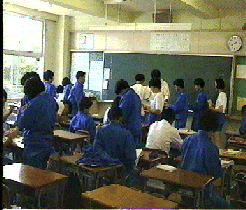
This is a photo of an average Japanese classroom. I want to point out a few things here. The Japanese classrooms are not wonderfully equipped compared to American classrooms. They don't have the most modern furniture in the world; notice the rather old-fashioned desks and the traditional but small bulletin board. From what I have read in various sources the typical Japanese classrooms are no better physically than American average classrooms. So, then, Japanese success in education is not due to their having wonderful rooms.
The Japanese schools also run quite counter to the American educational "experts" pronouncements on what is necessary for quality education. The "experts" cry over and over about the absolute need for small classes; Japanese classes, at least at the high school level, can have fifty or more students in a single class. The "experts" talk over and over about the need for "interactive" activities, "hands-on" explorations, and the need for much less lecture.
Yet the typical Japanese high school and middle school classes (at least from what I have read) are largely lecture with the students asking few if any questions at all. The students seem to get more help from their fellow classmates than their own teachers. The experts glorious "hands-on" activities exist, but at a lower amount than is trumpeted for American classrooms.
In effect, by the standards of American educational "experts", the Japanese schools ought to be a hotbed of failure and disruption. .
Yet which country has a 40% national drop-out rate? One guess.
One book I read by an American who taught in Japan described, in one part of the book, the lowest-level, worst Japanese schools. Oddly enough, the description of those classes and the behavior and attitudes of the students matches the average American classroom.
What is the distinction between the two countries? Why can the Japanese schools succeed even though, according to the rules of American "experts" their schools should fail?
That distinction is a desire to learn on the part of the pupils and a willingness on the part of the parents (usually the mother) to take an active interest in the education of their children. Until the American "experts" address this issue (as reflected in poor attendance and poor behavior in the classrooms) then all the glorious reforms that are undertaken will failure and the Japanese schools will continue to outpace American schools.
Changes I propose be made in U.S. education
In my opinion, American education is failing miserably. The fact that so many students drop out of school is bad, but especially bad in the modern day when job requirements have gone up, jobs are hard to get, and life overall is somewhat more difficult than it was say thirty or forty years ago. So, I think things need to be changed, and these are some of my ideas for those changes:
CHANGING THE AGE FOR DROPPING OUT
1. Students are required to attend some form of school through grade 8. After that, they can drop out on their own, with parental permission.
If, however, the parents refuse to give their permission, but the student continues to fail to attend school, only making a 'guest appearance' once in a while, and/or disrupts the classroom when they are there, then that student could be withdrawn from high school withdrawn from high school without the parent's permission. This would only be, of course, after attempts had been made to work closely with the parents to get their child to do what he or she was supposed to, and that is go to school and behave. Every effort possible should be made to get the student to cooperate but there must be a line drawn somewhere, and students who cross that line will be removed from the educational system.
Why? For the simple reason that there is a minority of students these days not want to go to school, they will actively disrupt school if forced to attend. It takes only a very small number of such disruptive students who care nothing about their own education to damage the education for the vast majority of students who do want to learn. School administrations these days tend to be very lax on discipline, going very far along the lines of saying how much they are doing, but not really doing much of anything in the long run.
vThere should also be a new category of expulsion: permanent expulsion from all schools. This would be used only in the most extreme of incidences, such as a student knowingly carrying and displaying a firearm in the school; attacking a teacher, or having a history of getting into physical fights with other students.
All of this would result in an actual situation where true learning would actually be encouraged in the classroom, and the teachers at the high school level would no longer have to spend a great deal of their time on students who did not want to be there and cared nothing at all about learning.
If they drop out, however, there will be consequences. No driver's license unless they get a GED or something like that. They will not be eligible for welfare. Further, they will be required to take part in some kind of national program which would be along the lines of community service. They would not be allowed to work unless they were actively involved in the community service program.
JUNIOR HIGHS, GRADES 7 AND 8
Junior high schools will have some form of educational programs during the summer. They will be both credit and non-credit courses, and will include:
a. Regular academic courses for credit. (Taught by regular teachers)
b. Courses on how to study, how to learn, how to take tests, etc.
c. Courses relating to crafts such as knitting, dancing, singing, etc. These will be primarily for fun. Parents could also take these courses.
d. Courses on computers; the most efficient way to do research, how to write term papers, etc. (These three will be taught by volunteers, including parents, teachers, etc. They will be sort of like “community courses” that some colleges run. Also note; c and d will also be available to parents.)
TEST FOR GETTING INTO HIGH SCHOOL
Students will take a high-school entrance test towards the end of 8th grade. What level they will enter high school will be determined by:
a. The results on their test (math, science, English, social studies)
b. Their discipline record. (If a student is a discipline problem in junior high, he or she will probably be a discipline problem in high school).
c. Any teacher/administrator recommendations.
vd. Whether they plan to attend college or not.
vThe results of all of these would be used to determine which level of high school the student would be placed in.
HIGH SCHOOLS AND LEVELS
High School will be divided into various levels:
a. Advanced Placement. These will be students who scored very high on the high school entrance examination, and who have had very high grades in both 7th and 8th grade. This is a college-oriented level.
b. College Preparatory. This will be for students who score well on the high school entrance exam, and who have decent grades in both 7th and 8th grades, and who plan on going to college.
c. Life Sciences level. This is for students who had generally low grades in 7th and 8th grades, a generally low score on the high school entrance exam, and who have no desire at all to go to college.
Most attention in today's schools is focused on the first two groups. I would like to see much more attention given to the third level, and this is the way I would like to see things organized for them:
All classes will be oriented towards things needed to know about vocational careers, and regular “everyday” types of things a person needs to know to function in society.
Courses will include:
1. Science
a. Biology: emphasis will be on ecology, human physiology as it relates to health issues, plants and animals as they relate to vocational careers, having pets, etc. Topics such as microbiology will be shortened and relate to human diseases. Topics such as evolution will be dropped. The result will be that the present-day biology textbook will have about a third to a half of its content dropped, and the other, more “practical” topics developed further than they are.
b. Physical Science: this will cover chemistry (with emphasis on how chemistry applies to everyday life, as in cooking), physics, geology, astronomy, and weather, and criminology. Also included will be fictional stories about science, such as an analysis of some science fiction stories and television programs, as to how realistic the science is, and how the science used effects the society on which it is used.
c. Historical Science: The history of natural and physical sciences. Uses and misuses of science. Atomic bomb. Aryan superiority. Evolution vs. Creationism.
2. Math
a. Basic Math: as it says, basic. Addition, subtraction, multiplication, division, fractions. Students must pass this level before they can take any other math courses.
b. Business and Household math: home accounts, how to manage checking accounts, how to pay bills, math relating to cooking and home repairs, etc.
c. Higher Math: limited overviews of algebra, trigonometry and geometry. This will be an optional course.
3. English
a. Basic English. How to write complete sentences correctly. How to take notes. How to write reports. How to research information in order to write reports. How to analyze newspaper and TV information as to its accuracy. The difference between fact and fiction. How to get the most out of reading, and how reading can actually be an acceptable pastime. How what is in a book, story, etc. relates to the conditions of the society under which it was written.
b. English II: Early American writers; writings about the Civil War; writings concerning the Great Depression; writings about World War II; writings about the Sixties; modern authors (including young adult novelists).
c. English III: English and the Mass Media. The concept of propaganda and how it is used. Censorship through history. English as used in television programs; the good, the bad, and the totally awful. How to determine what the plot of something is. Analyzing various stories and television shows as to the plot, and what is it trying to tell the person reading or watching? How to write a story. How to write a television script. Analysis of various stories and television programs and the type of English they use.
d. English IV: A more in-depth reading of various books, including some English classics, but emphasis on more modern books, including young-adult books. More in-depth writing by the students through the use of a journal. Students will also write short stories, plays and television scripts. Some independent study will be involved.
4. Social Studies
a. World History: The origin of human civilization. Scientific, literary, mathematical and social accomplishments of early cultures. Arguments and wars between cultures: why? World religions and their effect on their societies. Examine cultures of various countries, including their entertainment and food. Extinctions of cultures- how does that happen and why? Concept of race hatred and how it is caused and what the effects are. The Holocaust, slavery, anti-Oriental prejudice prior to WWII.
b. U. S. History: The life and culture of the Native Americans, good and bad. Why people came to North America. The various cultures that settled North America (Vikings, Spanish, English, French), and how they were alike and different. The American Revolution-what caused it? What were its effects? Class levels develop in the U.S. How they were alike and how they were different. The growth of the merchant class. The Civil War: what caused it, could it have been avoided, and what would have happened if it had ended differently. The Great Depression and its effect on the U.S. U.S. isolationism after WWI. WWII through posters and propaganda films, etc. The Vietnam War and the Sixties revolution. The Iraq wars, and their effect on American politics. The splitting of the nation into Republican and Democratic camps, and the growing intolerance of each for the other. This will also include some material on American geography.
c. Current Events in relation to Society, Culture and History: An analysis of current events, both worldwide, nationwide and local, and how those events have roots in the culture and history of the society in which they occur. Also, how these events impact, or fail to impact, upon the daily lives of the students and their relatives, and what can, if anything, be done about the events. Other topics would include Women's Suffrage, Black Suffrage, and analysis of printed and television ads relating to election campaigns. This will also include some material on world geography.
D. Psychology. An examination of psychology and how people think. Also examined will be the topics of philosophy and logic, and how they can be used in daily life. A study of mental illness through history, it's relation to the witchcraft trials, and how it is handled today. Psychology of inter-personal relationships, especially concentrating on marriage and how to settle disagreements between married and non-married people. Study of the concept of hate, and how hate has effected politics and culture through history, with concentration on Anti-Semitism in relation to the Holocaust, and attitudes towards homosexuality. How the use of ads are based on psychology.
5. Fine Arts
a. Fine Arts I: First part of course will consist of overviews of drawing, singing, performing and other areas of the fine arts. The rest of the course will separate students into groups based on their own interests, and a more in-depth study of whichever art or arts they are most interested in will be done.
b. Fine Arts II: A study of the fine arts found in various countries in the world, including how those arts relate to the history and culture of that country. This will also include television programs from those countries.
This is not meant to be complete. There are various other additions that could be made. I also understand there are problems of funding, but I think we owe it to the students who do want to learn to give them the best education that we possibly can.
Main Index
Japan main page
Japanese-American Internment Camps index page
Japan and World War II index page
|