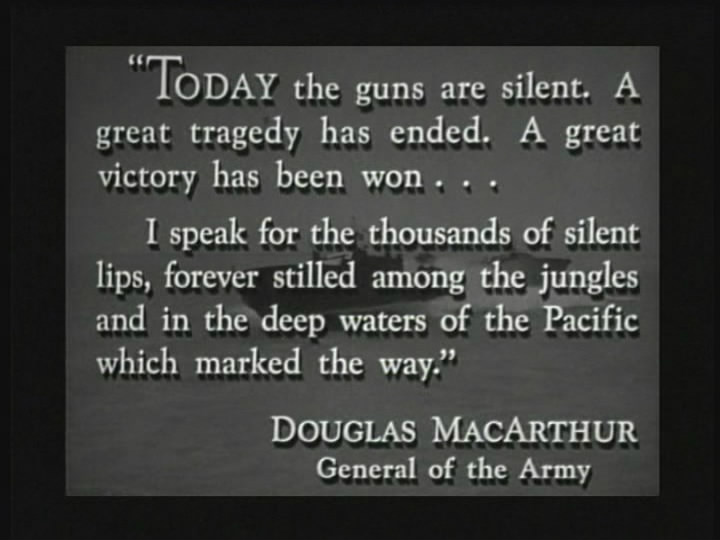
The black & white movie covers action in the Philippines from December 1941 through April, 1942, and is based on true events.
I will review the movie and include only a few scans, as this is an American movie and can be found easily.
The narrator before the film notes that Robert Montgomery, one of the film's actors, was actually in the war and commanded a PT boat crew. John Wayne is in the film, and so is Donna Reed.
The film opens with some PT boats being reviewed by Navy brass who, apparently, don't care a lot for the boats. The John Wayne character wants to be transferred to a destroyer, unsatisfied with PT boats.
Then the attack on Pearl Harbor happens and the US enters the war. The leader of the PT group wants to know what his group can do for the war. All he's given is an order for one boat to patrol, one to stand by for messenger duty.
The Japanese are heading to attack the place where the PT boats are and the PT leader has all the boats put out to sea. None of the boats are hurt, but the base itself is badly damaged.
They finally get orders to sink a Japanese cruiser. They manage to do that, but lose one boat in the process.
Then the film hits a lull, throwing in a romantic section. By this time in the film, they are on Bataan. The PT boats get orders to evacuate the top brass from Bataan and take them to another island where they can catch a plane to take them to Australia.
A couple of the PT crews end up being sent to the Army to help them out.
One of the guys being moved out is supposed to be MacArthur.
Then there's a portion where one of the boats is damaged and another has severe engine problems, so the last boat still working is towing them somewhere to get fixed.
There are a bunch of ships that are going to try to run supplies to the troops, and the PT boats have to stop some Japanese ships that are headed their way.
The boat John Wayne is in command of is destroyed, and two of the men are killed. Later his character and the leader of the PT group are ordered to go to Australia, leaving the men that are left from the group behind, as the US retreats. The two are to help build up the PT fleet.
The film is a fairly good one, though it does have minor problems. It has an obligatory love interest, which throws the pace of the film off somewhat in the middle. Early in the film there is an issue of sabotaged fuel for the boats brought up, but it never occurs again, so it's like there was something added there that no one followed up on.
It's also hilarious to read the normal disclaimer about the film doesn't depict anyone living or dead, and its totally plain that MacArthur is one of the people in the film.
It's also interesting to note the way the film was done, compared to the way a similar film would be done today, which goes to show how much our culture has changed in relationship to violence.
The film has a lot of explosions which is normal. It also has some men being killed during the fighting. Although the men are shot, there is no sign of blood, no sign of the bullets going through them, etc. It's a sanitized form of death.
In today's world, the blood and the gore are often forefront. In most pictures, this actually detracts from the films quality, in my opinion. Give me an old Hitchcock horror film over a modern blood-and-guts horror film any day. The writing is going to be better in the older film since they don't take up half the film with bloody special effects.
On the other hand, in a war movie, the same thing doesn't necessarily hold true. War is horrible, period. There is no sanitized war. It's ugly, it's dirty, it's vicious. People are killed in horrible ways, and sometimes it might be necessary to show that horror to get people to understand just how terrible war is.
For example, I was recently watching a Japanese film about the war and Okinawa, titled Song from the Canefields. It's a wonderful movie about a civilian family and how they are caught up in the war, but there are sections of the film, during the battles, where it's a matter of endurance trying to get through the graphic terrors that are unleashed. Yet, without those, the film would still be good but somewhat less effective in getting its message of “war is really horrible” across.
Main Index
Japan main page
Japanese-American Internment Camps index page
Japan and World War II index page