Summation No. 1: Non-Military Activities in Japan and Korea for the months of September-October, 1945
From the General Headquarters Supreme Commander for the Allied Powers.
This is a fascinating document which goes into how the occupation was going, but also has a lot of good information on the censorship and propaganda Japan used during the war on its own people.
Notice that the purpose of the Supreme Commander for the Allied Powers was to use and not necessarily support the government. This is returned to later when the document talks about the benefit of having kept the Emperor in place and not trying him as a war criminal.
The Japanese Imperial General Headquarters is dissolved, and the Japanese War Department is heading towards being dissolved. This also includes the Greater East Asia Ministry, which refers to the Japanese notion of brining all of “greater East Asia” under their control.
The Ministry of Education has dissolved the nationalistic Students' Mobilization Bureau. This is referred to later in the report.
 |
Another Ministry that was involved with propaganda (and other things) has been closed down.
 |
The Ministry of Justice was also obviously involved in censorship and “thought control” and has had those sections removed.
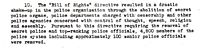 |
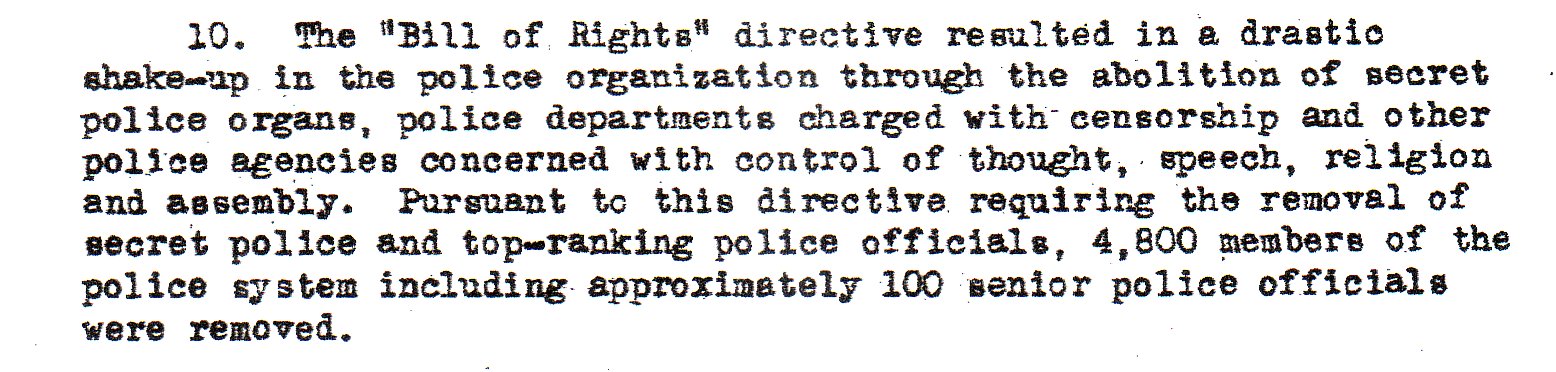
The Police Department is discussed next, with the secret police being abolished, and “police departments charged with censorship and other police agencies concerned with control of thought, speech, religion and assembly.” Almost 5,000 people were removed from their positions due to this.
 |
Another reference to freedom of thought, religion, assembly and speech.
 |
This one referred to stopping discrimination based on race, nationality, creed or political opinion. Apparently this did not include Burukumin, who are still discriminated against to this day.
 |
A bunch of previous acts that enabled the government to censor and control the thoughts of people, basically, are done away with.
 |
Political prisoners are freed. They numbered 507, and over 2,000 had been on surveillance.
 |
This part refers to pre-war groups that were militaristic in nature, and it was a broad range of groups. This all helps to explain why the Japanese people bought into the war so strongly; they had been exposed to almost nothing but pro-government, pro-militaristic ideas for a long time. Those who opposed those ideas, of course, were dealt with harshly.
 |
State Shinto is discussed in this portion of the document.
 |
 |
Other groups are dissolved, including a Religious Bureau in the Ministry of education, removal of government agencies used for censoring the media, a Student Youth Corps group, and the Greater Japan Political Association. This all gives one a good idea of just how widespread the effort was on the part of the Japanese government to control the lives of its citizens and to make sure they thought the way the government wanted them to think.
 |
“...all former restrictions on the collection and dissemination of information” are lifted. Of course, this actually isn't quite as generous as it sounds, since it refers to “former” restrictions. The Japanese were actually placed under a different form of censorship by the Occupation Forces, although the censorship was of a much more benevolent kind than the previous form.
 |
The Domei News Agency is abolished.
 |
Radio, movies and theater have responded well to the Occupation Forces, but newspapers have apparently not gotten out of their self-censorship mode from the war.
 |
This part talks about education. By the end of the war, education was at a “standstill” in Japan. There were very few textbooks, and too many teachers who bought into the “nationalistic militarism.” This is discussed later in the report.
|
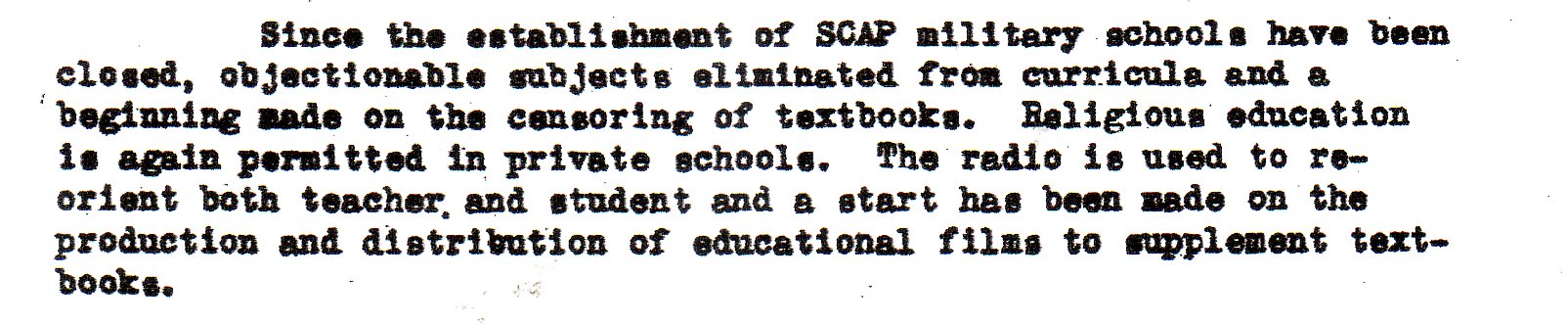
Steps taken to change the situation in education included doing away with the military schools, allowing religious education, and the use of radio and films to help basically un-brainwash the students and teachers.
 |
Teachers will be checked, and any “objectional” ones will be removed. In addition, any returning from the war will have to be vetted first before being allowed to return to their teaching duties.
 |
This is interesting in that it shows there were at least two million Koreans in Japan.
 |
Formosan-Chinese, Chinese, and other nationalities were also present in Japan at the close of the war.
 |
This is interesting. The Japanese government cannot arrested any of the Occupation Forces.
 |
The issue of war crimes comes up, with special attention given to POW camps.
 |
The Japanese government had to give the U.S. complete rosters of all of its soldiers involved in running POW camps.
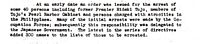 |
Forty persons were ordered arrested originally, but some 200 have been added since then.
 |
Back to the schools. A couple things were mentioned before, but this paragraph includes material about nationalistic teachers being dismissed, and the curricula being modified.
 |
The Board of Information was reorganized.
 |
The same group had all its censorship powers removed. The paragraph notes it “dominated” the press during the war.
 |
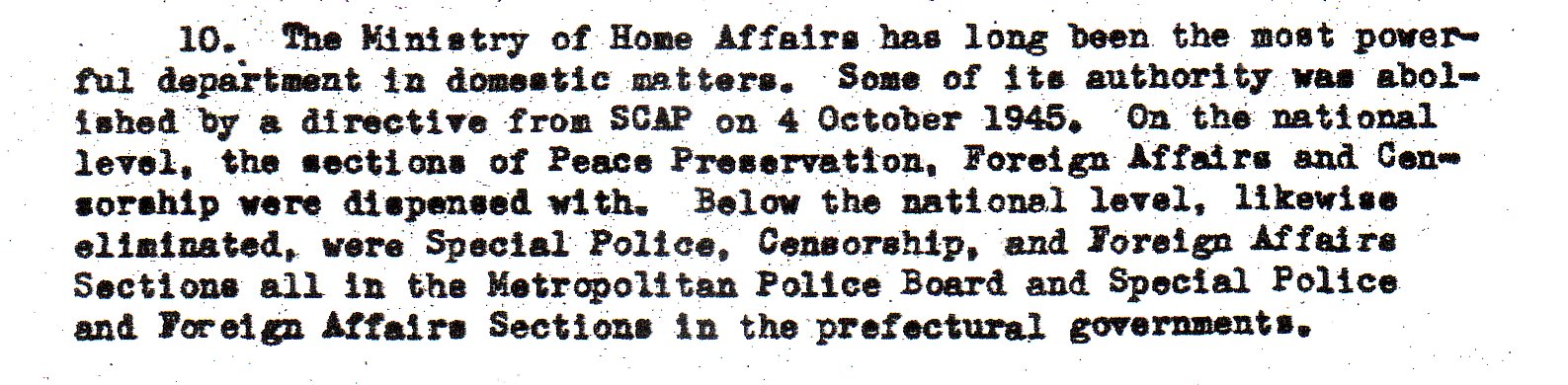
A bunch of groups related to the Ministry of Home Affairs are dissolved.
 |
There was concern over how the Japanese people would react to the Occupation Forces. Not stated in this report was the fact that anti-American propaganda had convinced many civilians that U.S. soldiers would loot and rape. The Japanese were basically shocked when the U.S. troops showed up and actually behaved themselves (within reason), gave candy to children, etc. Granted, there was a rather flourishing prostitution situation that did happen, but it was not something forced on anyone like the “Comfort Houses” were.
 |
The demobilization of the Japanese Army and Navy have gone very well.
 |
“Free thought and speech were completely suppressed by he special types of Japanese police.” This is something stated elsewhere, but is very important, because, again, it helped greatly influence the attitudes of the general civilian population of Japan. In my own opinion, the way the Japanese had been required to think, basically, would have been of great influence if the U.S. had done an actual ground invasion of the Japanese home islands, and the civilian death rate would have been atrocious since lots of civilians would have taken up the call to repel the American invaders.
 |
Another reference to political prisoners being released.
 |
Information on possible war crimes was gotten from POWs.
 |
More on information gotten from POWs.
 |
Almost every single POW was interrogated.
 |
Several hundred names of potential war criminals were obtained.
 |
 |
The Japanese government was told to apprehend around 300 people on war crimes possibilities.
 |
Tojo was a target for arrest, as were specific other people.
 |
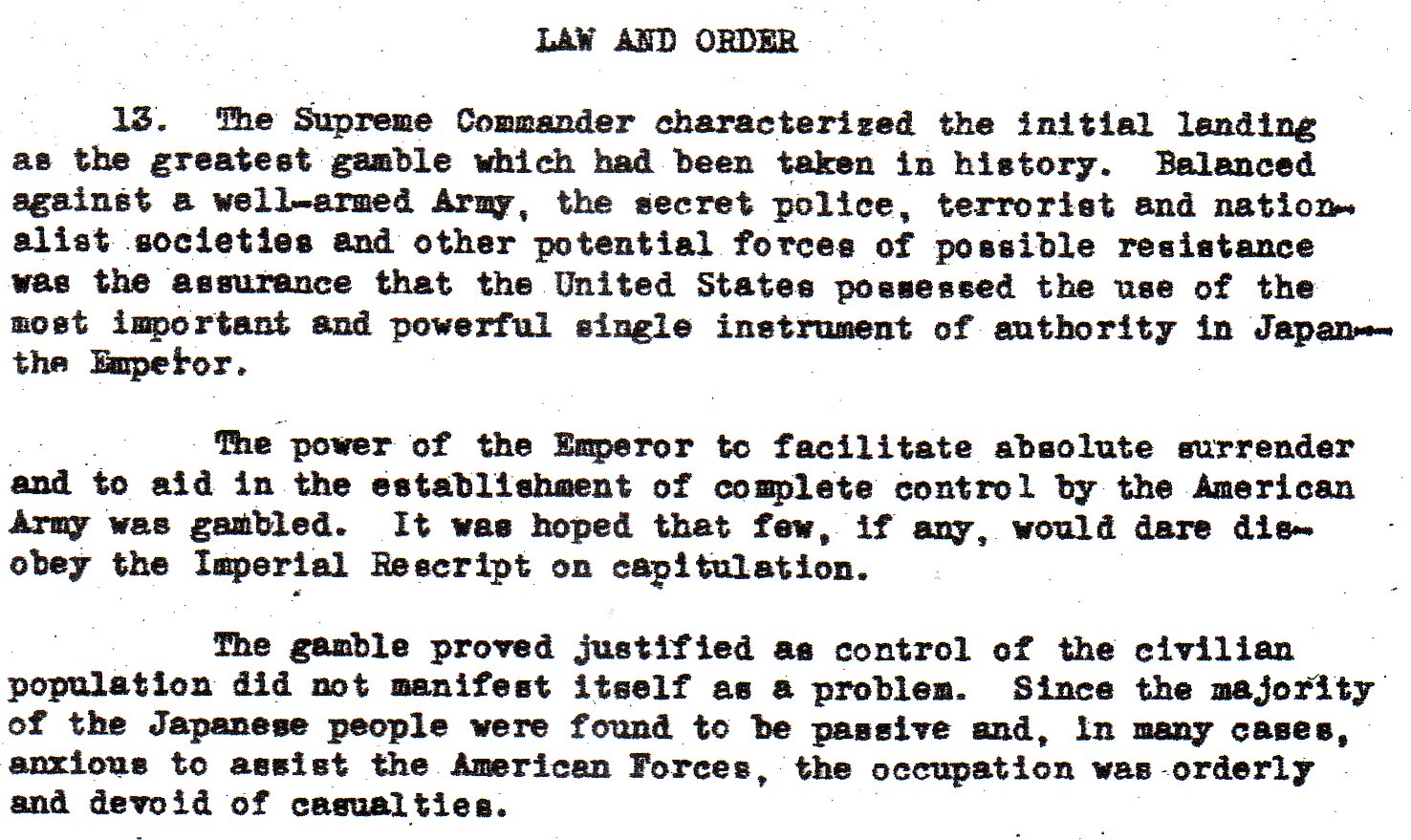
The gamble over not arresting and trying the Emperor paid off for the Americans, as these three paragraphs show. Things could have been very, very ugly.
 |
Japan apparently still had over seven million men in its military, with about four million of them still in Japan.
 |
 |
Another reference to the lack of freedom of thought that the Japanese civilians had been living under, and the role of the police in keeping them that way. The regular police had Army authority, and the Kempei-tai, or thought police, had authority under the Peace Preservation Act of 1941. The section also says the press and radio both were mouthpieces for the government.
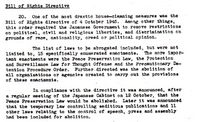 |
An October 4, 1946 order required the Japanese government to “remove restrictions on political, civil and religious liberties.. along with discrimination on the basis of race, nationality, creed, or political opinion. It's interesting that it took about a year after the occupation started for this type of order to be issued.
This included getting rid of a bunch of laws along with the Peace Preservation Law.
 |
The Japanese government was basically told not to make any false statements. During the war, for example, the government (through the controlled papers and radio) continually talked about all sorts of victories that never happened, and they inflated the results of the victories they actually achieved.
Freedom of speech was extended not just to the radios and newspapers, but also to the motion picture industry which had also been censored and controlled by actions of the government.
 |
Another reference to releasing political prisoners. The document tends to repeat itself quite a bit at times.
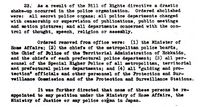 |
Another reference to the police, and how anything they had to do with censorship of anything is done away with.
 |
A couple of the newspapers have published things the Occupation Forces don't like and have been shut down for a day. There is something called “pre-censorship” in place of censorship, now.
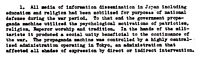 |
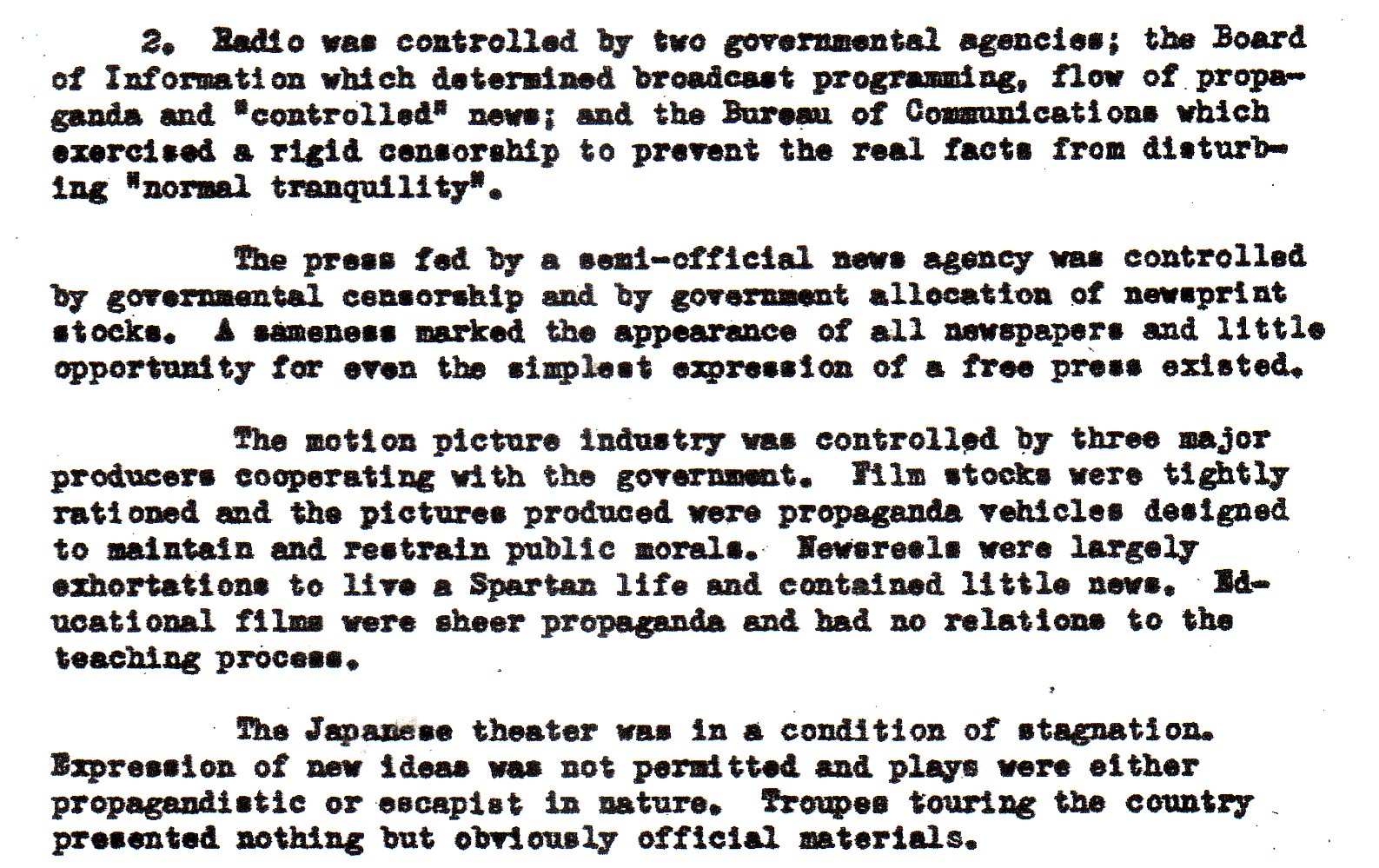
This paragraph explains the “propaganda machine” the Japanese government used, and helps a person to understand how so many people bought into the lies.
 |
Remember, there was no Internet and no TV at the time. Radio, papers, and theater films were about the only ways of the general public getting information. This section points out how the radio, press, theater and motion picture industry were all controlled by the government so the public would only hear, read, and see what the government wanted them to.
 |
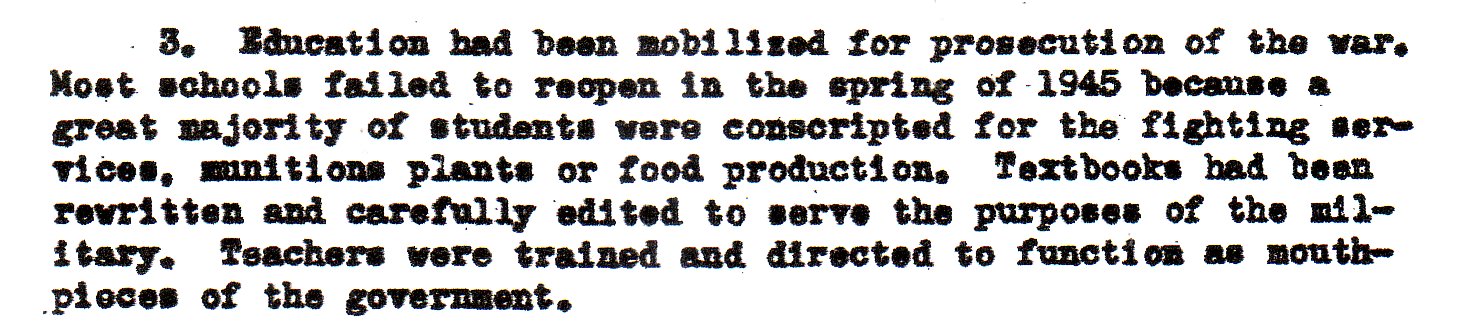
One other way people find things out is at school, and this paragraph notes that the government also used the schools for the war effort.
 |
 |
Religion was also controlled, and State Shinto was used also to help promote the war effort.
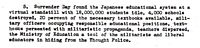 |
This goes into how bad the state of education was in the country at the time, with the schools lacking books and teachers, the schools a “tool of the militarists,” and most of the students no longer actually in school.
 |
Teachers who are “objectionable” have been removed, textbooks are being revised, and instructional films are being made to supplement the textbooks that do exist.
 |
This also goes into the educational system, and notes that, because it was highly centralized, it was easy to use a propaganda approach in it.
 |
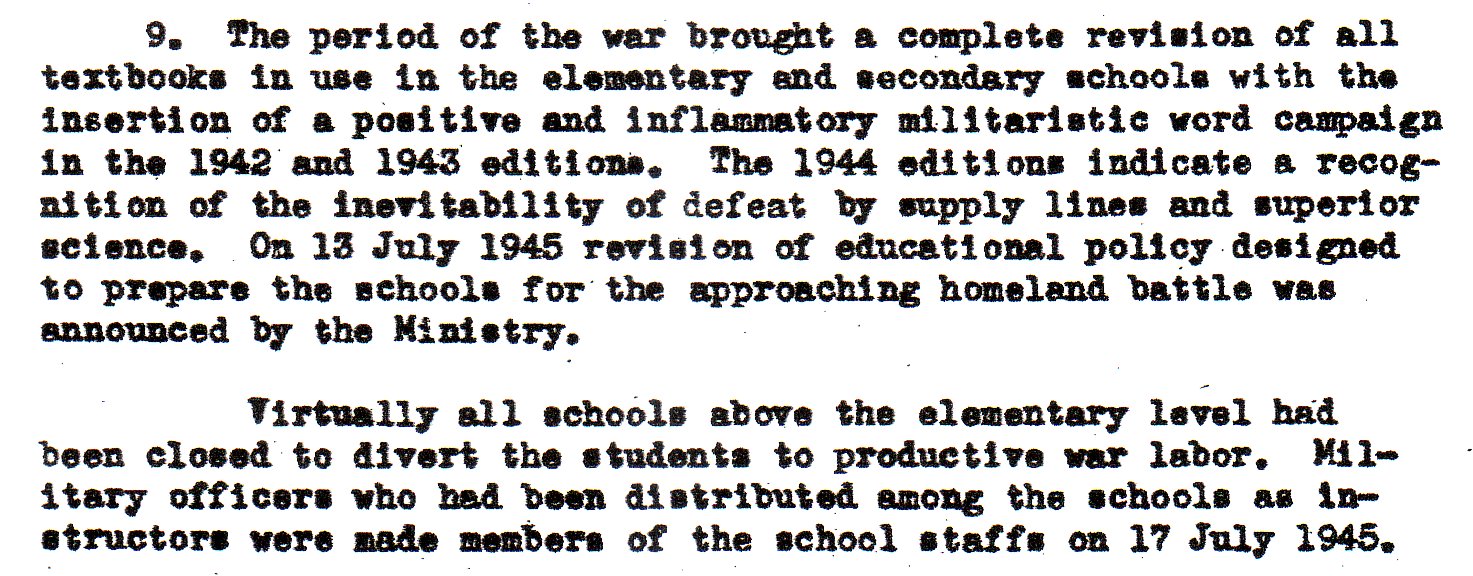
This section goes into how the textbooks were revised, and notes that all schools above elementary level were basically closed late in the war, the students expected to help in the war effort.
 |
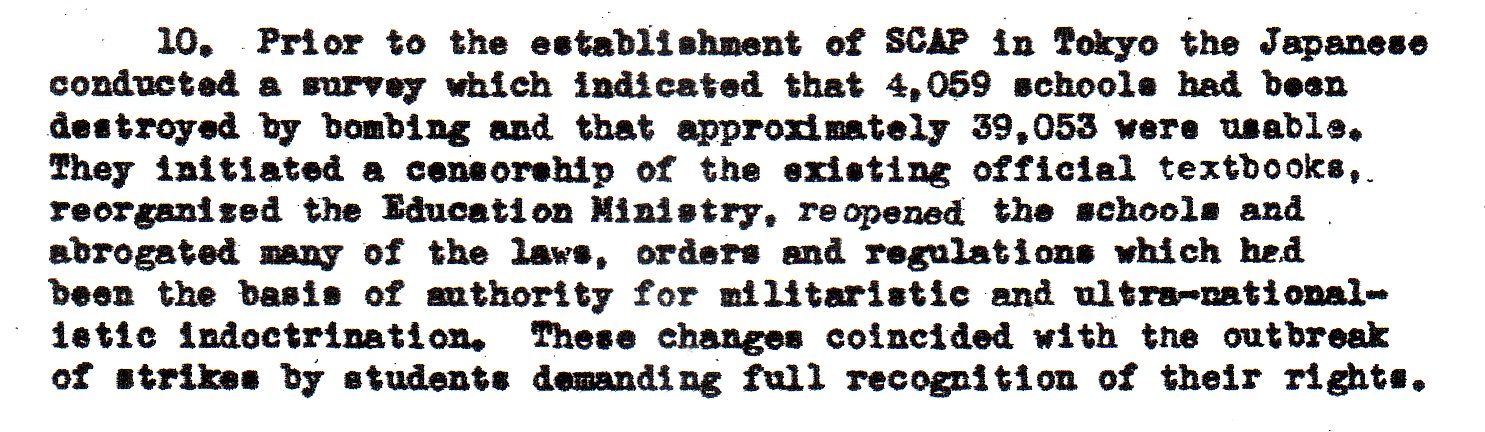
This goes into what the schools did in the occupation, and how there were student strikes.
 |
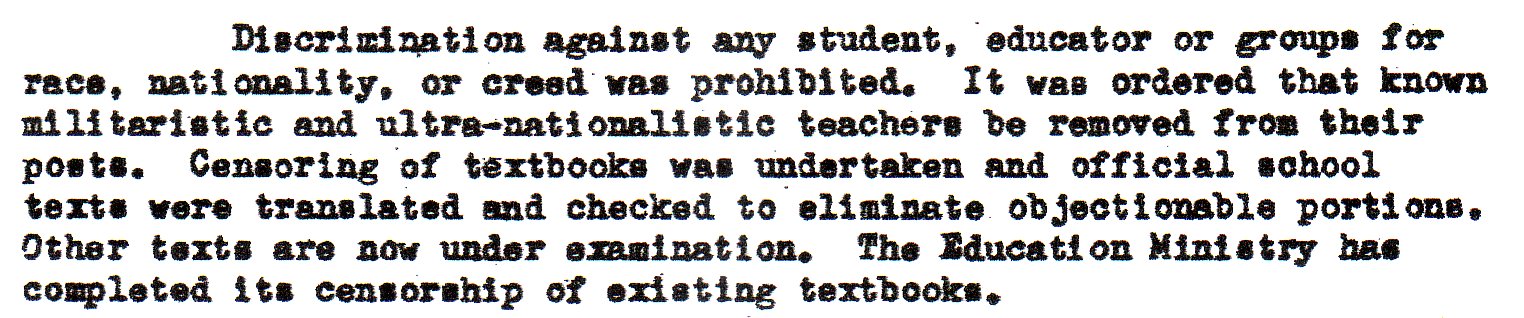
Another section that notes how the textbooks are being revised, how some teachers have been removed, and how discrimination has been outlawed.
 |
Another section on State Shintoism.
 |
Restrictions on freedom of religion had been political during the war.
 |
This goes into what the people were required to believe in State Shintoism. Japan was a land divinely created, and the Emperors were descended in an unbroken line from the sun-goddess. (Anyone who studies Japanese history releases that this “unbroken line” was not exactly “unbroken” at all.)
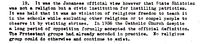 |
State Shintoism was officially not regarded as a religion, but a “civic institution” for instilling patriotism.
 |
This goes into some technical reorganization and restrictions on existing religions.
 |
It's noted that the press was under control of the government during the war, and how they are now changing.
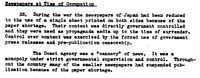 |
This section notes how papers had been reduced to a single sheet printed on both sides due to a paper shortage, and how many stopped publishing due to the shortage.
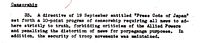 |
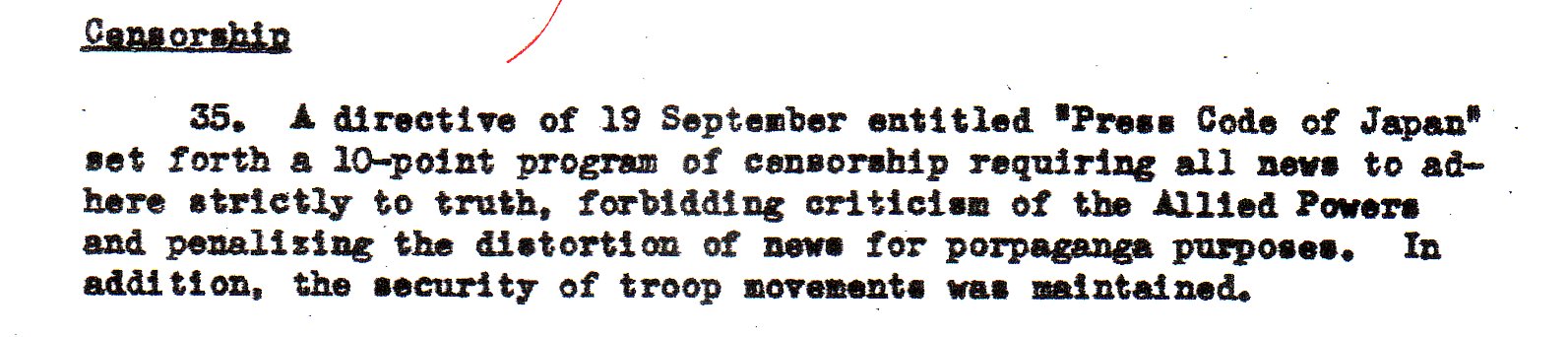
Although war censorship was lifted, there was still censorship, this time by the Occupation Forces. The papers could not print anything critical of the Allied Forces.
 |
This section repeats some other sections. Discussion of the Imperial family was now allowed.
 |
An interesting statistics. Before the war, 1,200 magazines were published in Japan. During the war, the number fell to 32. It would be interesting to know how many of the ones that stopped publishing stopped due to censorship, and how many stopped due to the paper shortage.
 |
Radio was a propaganda tool for the government.
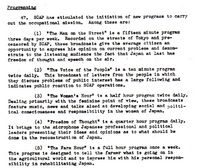 |
These are the types of programs that were being allowed and used by the Allied Forces.
 |
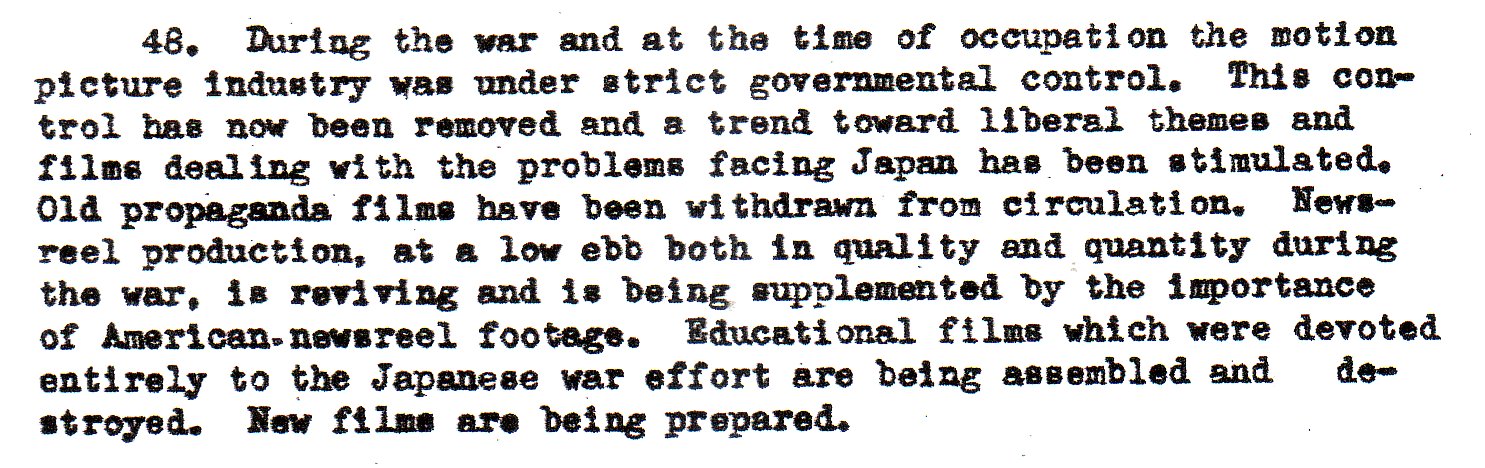
This is about the motion picture industry, noting that old propaganda films had been withdrawn.
 |
The number of motion picture theaters declined sharply during the war, largely due to bombing and fire.
 |
Production of films went from 500 feature films per year before the war to around a hundred. This section also notes that some in the industry did not agree with the government efforts to control production.
 |
The Japanese government is ordered to remove its control of the motion picture industry.
In a very unfortunate move, the Allied Forces examined Japanese films, removing half from circulation and ordering them to be destroyed. That's a really, really dumb move, although quite characteristic of conquering nations in virtually any war.
The films should have been kept and preserved as historical relics, basically. Once destroyed, they were lost forever. It's no better than burning libraries.
There was almost no war guilt among the Japanese at first.
The Allied Forces have given the people of Japan solid information on Japanese atrocities committed during the war.
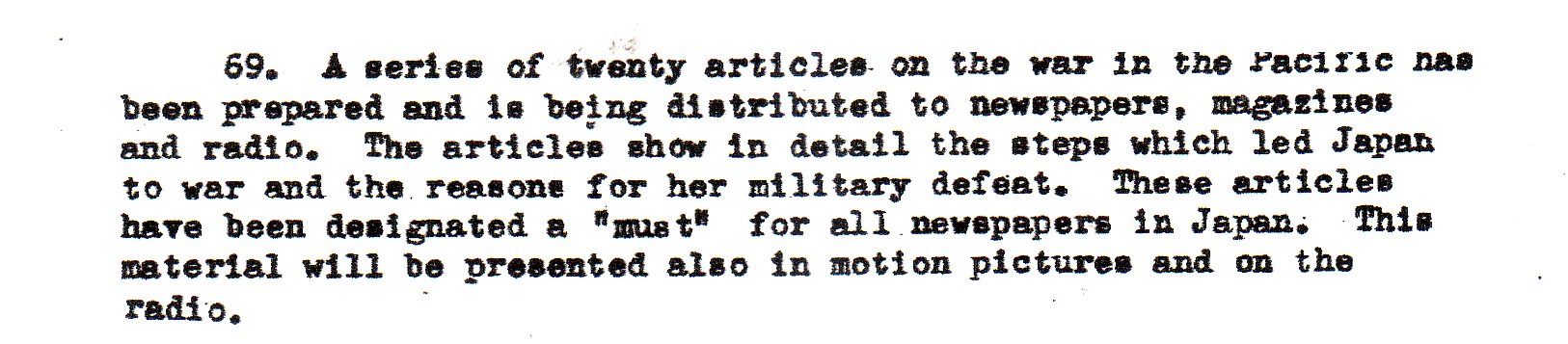
“Official” articles on the Pacific War are going to be given to the papers, who will have to run the articles.
There is a growing sense of war guilt.
How the Japanese militarists controlled thought.
Another reference to getting rid of controlling laws.
People will now be allowed to discuss the Emperor and the Japanese government.
Main Index
Japan main page
Japanese-American Internment Camps index page
Japan and World War II index page
|