
Chapter 3
BY the time Pepita had reached home her mood had changed-her anger was gone, or at least the signs of it were. She sang as she prepared the supper, and chatted gayly;- with Jose. It appeared that, after all, she had enjoy-ed the bull-fight; it had even been better than the others; she had had great pleasure. She made delightful little jests about everything; she recounted the names of the people she had seen and known; she described to him the dresses of the girls, the airs and graces of the men. She laughed, and obliged Jose to laugh also, and all the time she looked so pretty, with the queer light in her eyes, the gleam of her little wicked white teeth, and the brilliant spot of color on her cheeks, that she was enough to turn one's head.
The moon was at its brightest that night. All the earth was bathed in pure, magic whiteness-the whiteness which somehow seems to bring perfume and stillness and mysterious tenderness with it. Such a night! One breathed roses and orange blossoms and jasmine. Pepita sat under the roses and sang and talked, and Jose smoked and was happy, but still in a state of bewilderment, though the stillness and beauty of the night soothed him and made him content to ruminate without words.
Jovita fell asleep. She always fell asleep out-of-doors on the warm summer nights, and indoors by the fire when it was winter. Pepita ceased to talk, and sang one little song after another; then she even ceased to sing, and only touched her guitar softly now and then. After a while Jose, who had stretched himself upon a bench, fell asleep also.
Pepita ceased to touch her guitar. She looked out at the flowers sleeping in the moonlight, and for a few minutes was very still; then she laid the guitar down and stepped out into the brightness.
In the light of the moon one cannot see the color in a face. Perhaps this was why hers seemed to be gone. She looked quite pale, and her lovely little brows were drawn together until they made a black line across her forehead. She clasped her hands behind her head, and with her face a little thrown back, so that the light fell full upon it, wandered out among the trees and fragrant flowering things. She liked the jasmine best, and over one part of the low, rough wall there climbed one which blossomed with a myriad stars. So she went and stood by it,
and looked now at it, now up and down the road, which the moon had made into a pa-ch of snow.
And as she stood there, suddenly there started up on the other side of the wall the figure she knew so well, and the next moment it had vaulted over and was close to her. Sebastiano!
She stood still, her hands still clasped behind her head, her face still upturned, and looked at him.
He folded his arms and looked at her. As for him, whether the moonlight was to blame or not, he was as pale as death.
"Yes," he said, "you are always the same. You do not change. One may come at any hour. But listen to me. You think I have come to reproach you. Why should I? I have fought bulls, but that does not teach men how to deal with women. I thought that, if a man gave you his soul and his life and the breath of his body, you would listen some day and let him think of you. You are a woman, and you are made to be loved; but there is something hard in your heart. You are proud of having mocked a man who was honest and loved you. But hear me: it is better, after all, to be less pretty and more a woman."
He stopped an instant. She had changed her position, and stood by the jasmine, stripping,the blossoms from it one by one. She began to smile and sing softly, as if to herself:
"Oh, bird at my window,
Sing but one song to me,
My lover who is light and gay."
"And more a woman," said Sebastiano. "It is women men want."
Pepita looked up and laughed; then she sang again:
"Who stirs the blossoms in the night,
Who breaks the orange flower."
Sebastiano made a swift movement and caught her wrists, his eyes flashing fire.
"That is nothing," he said. "You are woman enough. The time will come. It will not be always like this. You can be made to love. Yes, you are one of those who must be made. Then you will suffer too, and it will be good for you. You will speak then."
He paused a moment, and held her arms a little apart, looking at her with a sudden change to mournfulness.
"How pretty you are!" he said. "How little and how pretty! If you were good and gentle, and one might touch your cheek softly or stroke your hair, how one would love and serve you! No, you cannot move. I have not fought bulls for nothing. If I let you move you will struggle and hurt yourself. Listen. I am going away. I will trouble you no more now. I will wait. If one waits long enough, pain ceases and one forgets. It is so with a wound, why not with what one feels for a woman- I said you could be made to love; but let that be left for another man to do. I want no love like that. I want a woman. Some day you will not cast the devisa under your feet. You will take it and hide it in your breast. It will not be mine, but some other man's who loves you less. I loved you, I was mad for you; but it shall cease. It is better to think only of the bulls than to play the fool for a woman who has no love in her heart. You are pretty, but that is not everything. You can work spells, but a man can break through them. There! Go!"
He gave her one long look, flung her hands aside, and had vaulted the wall and was gone himself one moment later.
Pepita stood still with clinched hands dropped at her side, staring with wide fierce eyes down the white moonlit road.
The next evening Jose came home from his work later than usual. He came down the road with a drooping head and a slow and heavy step. When he sat down to his food he ate but little, and as he bent over his soup he heard Jovita scolding.
"It is gone," she was saying. "You took it, and have thrown it away."
"Was it not mine?" said Pepita. "It was mine. I cared nothing for it, and have done what I chose with it."
Jose lifted his head and listened. "What has happened?" he asked.
"She has thrown away the devisa, which I had saved," answered Jovita. "I laid it away, and she has taken it. What harm did it do her that it should lie out of her sight in peace?" "Did you do that?" Jose said to Pepita.
"Was it meant for her?" said Pepita. "I told you he ought to have thrown it to her and not to me."
Jose broke a piece of bread and crumbled it on the table mechanically.
"You need not have done that," he said. "I wish you had left it in its place. It did no hurt, and we shall not see him again. He is not coming any more. And soon he goes away; and who knows what may happen?"
Pepita walked out of the house without speaking. She did not come back for a long time, and they did not know where she had gone; but as that was her way when she was in a naughty humor, they were not anxious about her.
When she returned at last the moon was shining again, and Jovita was asleep in the shadow of the vines, and Jose sat on the bench outside the door, smoking.
Pepita sat down on the threshold and rested her head against the side of the door. She said nothing at all, and only looked out at the dew laden flowers sparkling in the garden.
There was silence for several minutes, and then Jose turned uneasily and spoke.
"Yes," he said, "he will not come again; and soon he goes away. It is for the best. He is very strong and determined. Perhaps that comes of fighting bulls. He said he wanted you, but you did not want him, so he must forget about you. He must cease to think of you or hear of you. He asked me as a friend not to let him see me for a while, until it was over. To see me would remind him of you, and that would not do. He asked it as a friend-there was no unkindness-he is my friend, yes, though he is Sebastiano and I am only a poor fellow who works hard. It will all be as well as ever between us when it is all done with and we meet again. If you had wanted him we should have been brothers."
Pepita sat still. What strange thing had happened to her? She did not know. Something was the matter with her breathing. Something hurt her side-labored in it with heavy beatings like blows which suffocated her. She shut her hands and drove the nails into her palms. She could not have spoken for the world.
Before Jose could say more she rose with fierce suddenness, and passed him, and was gone again. The poor fellow looked after her small swift form mournfully.
"If she had wanted him," he said, "he would have made her a good husband, and we should have been brothers. But she is not easy to please, and she would not give one a chance who did not please her at first. And there is no one who slays a bull as he does!"
Pepita flew like a bird until she reached the low wall where the jasmine grew, at the spot where she had stood the night before. There she stopped, panting. The breath of the jasmine filled all the air about her. She looked up the white road.
A strange new passion filled her. She did not know whether it was anger or not, but if it was anger it was of a new kind, with more pain in it than she was used to. He would not come again-not at all again! He would not appear at her side as if he had sprung from the earth; he would not follow her or plead with her, or look at her every moment he was near her; he would not try to make her speak. Only last night he was here in this very spot, and now he would never speak like that again. He would forget her, not care for her-forget her, Pepita.
She would not believe it. She knew he could not-they never did; they always loved her best and wanted no one else. And still the labored throbbing went on in her side and she panted for breath.
"Come back," she cried, looking up the white road. "I tell you to come back. You shall. Do you hear? I tell you-I-Pepita!"
But there was no answer, no sound of any footstep, no sign of any advancing shadow. The road stretched out its white length in utter solitude, and a strange, wild look came into her beautiful little face.
"Do you not hear?" she persisted. "I will not speak to you if you do come; I will give you nothing; I will not look at you; but you shall come because I will it-because I am Pepita."
Still there was only silence and loneliness. Suddenly she flung out her hands and stamped her foot.
"I will kill you," she said. "If you do not come-I will kill you!"
Then almost immediately she put her clinched hand to her beating side and sank down upon the earth, burying her face in the dew-wet fragrant tangle of the jasmine.
But he did not come back. And yet every night she went and stood by the low all, and looked up the white road and watched and waited. For a long time she did not know what she intended to do if he should appear. All was vague in her mind. At first it seemed only as if her whole being went out into the fierce demand that he should come, and the obstinate proud belief that it must be as she wished-that he could not resist and disobey her. Who had ever disobeyed her? Not Jose; not Jovita, for all her grumblings; not any of those others. And was it likely that he who had adored her more than all the rest, who had watched her with that hungry love in his eyes, could do what no other had ever done? She told herself this over and over again; but he did not come. She began to feel a feverish eagerness when she dressed herself, a passionate desire to be pretty-to be prettier than ever before. She used to stand before her scrap of looking-glass to try on one bit of simple finery after another, twisting up the soft cloud of her hair afresh a dozen times a day, and putting a fresh flower in it. She went to the well again and again and filled her jar, and emptied and filled it again, and lingered, and tried not to look round when she heard a footstep; but the right one never came, though her heart's throbbing shook her many times in false alarm. She was only a child-a passionate Spanish child, ignorant and full of fierce young natural impulse sand she knew only childish, crude methods. So she made herself beautiful, and showed herself in the places where she thought he would see her and be unable to resist her will and her beauty; but though she made Jose take her here and there and everywhere, she never saw Sebastiano.
Pepita clutched her fan until she broke it, and a wild exultation sprang in her breast. She had seen before she left home that she had never before been so pretty. There had come into her face a new look-a fire that had burned deeper every charm. He would see-he would see that she was Pepita still, and that he could not keep his word if she chose-if she chose.
He drew nearer and nearer, still not seeing them. He was talking to the three companions who were with him. He was richly dressed, and looked stronger than ever, and more handsome and graceful. He came still nearer. 'No, she would not speak to him. No! He looked up and his eye fell upon them-upon Jose and Jovita and Pepita! He drew back a step and stood still; he made a low bow to them, a grand bow, such as he made when he was in the bullring and the people applauded. He turned away and passed on. Yes, without a word. Jose sighed a deep and mournful sigh and rose to his feet.
"Come," he said. "We must go. It is best not to stay. He does not wish to see us, and he asked that I would keep away. It is a pity --but he asked it."
The breath was coming in sharp little puffs through Pepita's delicate nostrils. It was as if she had been struck a blow. She walked home as in a sort of delirium; she saw none of those who turned to look at her. She walked faster and faster. Jovita could not keep pace with her.
"What is the matter?" said the old woman. "You walk as if you had a devil in you. Your breath is all gone. Are you mad?"
At night, when they sat together, Pepita spoke of the next bull-fight. Jose must take her. She wished to go.
"It is better that we should not go there," said Jose. "You know why. He will not like to see you. You saw how it was to-day. He is not angry, only he is determined not to be reminded. Soon he will go away, and then you shall go with me as often as you wish; but not now. After this week he will be far away-far away."
"I will go now," said Pepita. "I will go without you if you will not take me. Isabella and Juan and Manuel will be glad enough. Let him-let him look at his bulls."
She did not know that it was desperation that had seized upon her; she thought it was defiance. Yes, yes, she told herself breathlessly, he should see her laugh and talk with 'Manuel, and Carlos and Juan and the rest; and then he would be punished.
She would hear nothing that Jose said. She would go-she would go. No other bull-fight but this would please her.
She could scarcely live until the day arrived. She had made for herself a new gala-dress; she had a new fan and a necklace she had bought out of her little savings.
There was a great crowd. It was known that Sebastiano was to go away, and many had come for that reason, wishing to see him for the last time in the season.
At first Pepita was gayer than her adorers had ever seen her. She deigned to talk and smile and listen. She had the restlessness and color of some brilliant-winged bird. Isabella looked at her in wonder.
"She was never like this before," she whispered to Juan.
And then Sebastiano came, and for the time they saw only him.
When at last the bull lay an inert mass in the dust, and the people shouted and almost flung themselves from their places into the arena in their excitement, and the gay and superb actor bowed to them-bowed to them again and again -Pepita sat like a little image of stone. She was quite colorless, and her eyes were fixed. She seemed to hear and see nothing until some one spoke to her. Then she rose and looked at Manuel.
"It is too hot," she said in a low voice not like her own. "I must go. The sun. I have a pain in my head. Come."
He had not lifted his eyes once to her. It was as if she had not lived-as if she had been Isabella or Carmenita-and he did not give her a thought. No, he had not once looked up.
The next day he was gone. She heard Jose say so to Jovita, who grumbled loudly. She had forgotten her old distaste for these "fine ones."
"And but for her humors he would have stayed," she said. "What more does she want than a fine well-built man like that-a man who is well-to-do, and whom every other girl would dance for joy to get? But no; nothing but a prince for her. Well, we shall see. She will work for her bread herself at last, and serve the other women who have homes and husbands."
In the middle of the night she was awakened from her slumbers by something-she knew not what. Soon she perceived it was Pepita, trembling.
"What is it now?" demanded the old woman. "I stayed out in the dew too long," said Pepita, "and I am cold."
"That is well," said Jovita. "Get chilled through and have a fever, that we may ruin ourselves with doctors' bills; and all because you choose to remain in the night air when you should be asleep."
Pepita lay on her pillow, her eyes wide open in the darkness, her small hot hand clutching against her breast something she had hung round her neck by a bit of ribbon. It was the Wisa she had stolen from Jovita, and which had not been thrown away at all. In the daytime it was hidden in the bosom of her dress; at night it hung by a cord and her hand held it. By this time a sort of terror had mingled itself with her passion of anger and pain, and she lay trembling because she was saying to herself again and again:
"I am like Sarita! I am like Sarita!"
She said it to herself a thousand times in the weeks and months which followed, and which seemed to her helplessness like years. She said it in as many moods as there were hours of the day. Sometimes with wild unreasoning childish rage; sometimes with a shock of fear; sometimes in a frenzy of shame; sometimes, as she stood and looked up the road, her cheeks pale, her eyes dilated with self-pity and tears.
"I am like Sarita! Yes-Sarita!"
She remembered with superstitious tremor all the things that had been said to her of the punishment that would fall upon her because of her hard-heartedness. She remembered Jovita's prophecies, and how she had mocked them; how cruel she had been to those who suffered for her; how she had laughed in their faces and turned away from their sighs. She remembered Felipe, whom she had not spared one pang-' Felipe, at whom she had only stared in scorn when he wept and wrung his hands before her. Had he felt like this when she sent him back to Seville to despair?
A cruel fever of restlessness burned her. She could find pleasure no more in the novelties of the city, in the gaieties of the gardens, in her own beauty.
Sometimes she was sure it was magic-the evil eye. And she slipped away, poor child! and knelt in the still, cool church, and prayed to be delivered.
But once as she was doing this a sudden thought struck her.
"Not to think of him any more," she said, knitting her brows with yet another new pang. "Not to remember his face not to remember his voice and the words he said'. No. no!" And her rosary slipped from her fingers and fell upon the stone floor, and she picked it up and rose from her knees and went away.
All that day and night she thought and thought, and the next day went to pray again -but not that she might be delivered. She brought to the shrine at which she knelt substantial promises as offerings. Hers were not the prayers of a saint, but of a passionate, importunate child, self-willed and tempestuous. She would not have prayed if she could have hoped for help from any earthly means. She had never prayed for anything before. She had always taken what she wanted and gone her way; but she had had few needs. Now in this strange anguish she could do nothing for herself, and surely it was the place of the Virgin and the saints to help her. She stormed the painted wax figure in its niche with appeals which were innocently like demands.
Make him come back-make him come back to her! Mother of God, he must return! 'Make him come to the wall some night-yes, to-night! He must not know that she was like Sarita, but he must come; and whatsoever she did or said he must not go away again. She would sell her new necklace; the silver comb her mother had left her-the comb her father had given her mother in the days of their courtship; she would do some work, and give to the Holy Mother some candles and flowers; but he must come back, and he must not go away again whatsoever she did.
She knelt upon the stone floor, her hands wrung together, pouring forth the same words breathlessly over and over, each reiteration more intense than the last, all her young strength going out into the appeal.
And still she had not yet reached the point of knowing what she should do and say when he came.
When she tried to rise to her feet she was obliged to make two efforts before she succeeded. She had given such a passion of strength to her siege that she was almost exhausted, and she went out into the dazzling sunlight trembling. She did this day after day, day after day, and at night she waited by the wall, but the road was always the same.
And she could hear nothing-not a word. She could not ask, even though sometimes as she sat and gazed at Jose with hungry eyes it seemed as if she must drop dead if he did not speak. But he did not speak because he could have told her but little, and was quite secure in his belief that the mere mention of Sebastiano's name angered her.
So the time went by-weeks and months and at last one evening she went to the church and prayed a new prayer.
"Sacred Mother," she said, "I have sold the comb and the necklace, and I have worked and can keep my word. I have bought a little golden heart. And if he comes"-in a fainter whisper -"if he comes I will say nothing ill to him."
That night, for the first time, she heard of Sebastiano.
Little Carlos came in and was full of news. "They say that Sebastiano has had great success, and that perhaps he will go to America." "Where is America?" asked Jorita.
"It is at the other end of the world, and never yet have the people seen a bull-fight." "Never?" said Jose, staring. "That is impossible!"
"It is true," answered Carlos. "And they are rich, and like new things; and the king has spoken of sending for Sebastiano. He will be rich enough to build a palace for his old age."
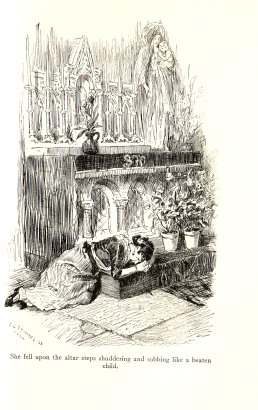
A few days later, in the dusk of the evening, there crept into the church a little figure familiar to the painted saints and the waxen Virgin. But to-day it wore a changed aspect. It moved slowly at first, reluctantly; the brilliant little face was pale; the eyes wild with torture. A moment it stood before the altar, and then flung up its arms with a fierce gesture.
"Mother of God," it cried brokenly, "then if it must be so-tell him-tell him that I am like Sarita!" and fell upon the altar steps shuddering and sobbing like a beaten child.
p>AND yet it was again weeks and weeks before she heard another word. In those weeks there were times when she hated Jose because he never once spoke of what she wished to hear. She could not speak herself-she could not ask questions; she could only wait-hungry and desolate. They would not even say-these people-whether he had gone to the king of America or not; whether he was at the other end of the world, or whether he was only_:- in some other city. The truth was that Jose had innocently cautioned the others against speaking of one whom Pepita disliked to hear of.
"She does not like him," he said sorrowfully. "Girls are like that sometimes. It makes her angry when one talks of him."
But slow as he was, he could not help seeing in time that something was wrong with Pepita. Sometimes she scarcely talked at all, and she did not flame up when Tovita grumbled; it seemed as if she scarcely- heard. Her eyes had grown bigger, too, and there was a burning light in them. They always appeared to be asking
something; often he found himself obliged to look up, and saw them fixed upon him, as if they meant to wrest something from him. The careless birdlike look had gone, the careless birdlike laughter and mocking. He began gradually to fancy she was always thinking of something that hurt and excited her. But then there was nothing. She had all she wanted. She had as many trinkets as the other girls; she had even more. She had so little work to do that she had sought some outside her home to fill her spare moments, and she loved no one. There was not a man she knew who would not have come if she had smiled. What, then, could it be? And how pretty she was! Prettier than ever; prettier because of the burning look in her eyes, and-and something else he could not explain; a kind of restless grace of movement, as if she was always on the alert.
"Are you not pleased with Madrid any longer?" he asked her once.
"Yes," she answered. "Do you want anything?" "No."
"It seems to me," he said slowly and with much caution, "that you do not amuse yourself as you did at first."
"It is not so new," she said; "but there is still pleasure enough." And for a moment she kept her great eager eyes fixed upon him, and then she moved slowly toward him and touched him with a soft touch on his big clumsy- shoulder and said: "You are a good brother! You are a good brother! "
"I have always loved you," he said with simple pride. "When we were children, you know I always promised that you should see better days."
She had forgotten to count the weeks and days, or to take note of the changing seasons, when one hot day in the early summer he came in-Jose-with an innocent joy in his face.
He looked questioningly at Pepita two or three times and then coughed.
"You will not mind now," he said. "It is so long ago, and it is all over. Sebastiano has come back. He did not go to America; he is in Madrid to-day. He came to me in the street; he did not avoid me; he was rejoiced to see me. It appears that it is all well with him. Afterward Manuel told me. It appears there is a very pretty girl he met in Lisbon-she is here now. It is said he will marry her."
Pepita clinched her hands and stared at him with eyes that burned as never before.
"It is not true!" she said through her teeth. "It is not true!"
Jose fell back two steps.
"Not true?" he stammered. "Why not? They say so."
"A man who slays bulls as he does," she said, "does not forget a woman in a day."
Jose was lost in amazement.
"I thought you believed nothing but ill of him," he said. "What has happened? You are angry-angry."
"It is not true about the girl from Lisbon," she said. "It is a lie they amuse themselves with."
Never had innocent Jose been so thunderstruck. This was beyond his understanding. He was afraid to speak, and kept looking side wise at her as he ate his soup; but she said no more.
"What has happened?" he said to himself over and over again. "Will she not allow him to marry another, though she does not want him herself?"
Later he went out again. It must be confessed that he went in the hope of seeing Sebastiano, or at least hearing of him. There was no difficulty in hearing of him. In the wine shops and at the street corners he was being talked of in every group. Of what else could people speak who knew he had returned? How there would be sport-how there would be pleasure! Life began to wear a more vivacious aspect. And what had he not done since he had left Madrid? Such success-such adulation! The impression among his adorers was that the whole world had been at his feet. Here and there one could hear snatches of song of which his name was the refrain. It was only because he so loved his own people that he had refused the magnificent offers made by the kin,,, of America. He had refused them; he had chosen to remain in Spain. He had come to Madrid. Soon he would appear before them again. He had even gained in strength and dexterity; and as to his good looks-ah! what a dashing, handsome fellow!
Jose had the good luck to see him again, even to speak to him. What fortune what happiness! The honest fellow felt himself overjoyed. They were to be friends again.
It was quite late when he found himself walking homeward over the white road again. He had drunk wine enough to make him feel quite gay; and as he went he sang now and then a verse of a song about the joys of the bullfight.
When he was about half-way home he thought he heard behind him the sound of rapid feetlight feet running. He stopped and looked back. What was it he saw, or thought he saw, Was it a small dark shape which flitted instantly into the shadow of the trees? It looked like a woman who did not wish to be seen. Well, he would not look, then. What was the use of giving her trouble? He tramped on, perhaps a little more slowly. It was late for a woman to be out on the lonely road alone. It must be past midnight. Then the thought came to him that perhaps she wished to pass him. In that case he might look the other way, on the opposite side of the road. In fact, he crossed to the other side to leave the way clear, and went on good naturedly, singing his song loudly and all out of tune. Yes, he had been right. Soon the footsteps drew nearer; the shadow within the shadow slipped past-ran swiftly. But by that time they were nearing his home, and there was a stretch of road unshaded by anything. The shadow hesitated, darted across the white space, and Jose, seeing it in the full light, uttered a cry, and started in pursuit. In but a few moments he had reached it and held it by the arm, feeling all the slender body breathless and panting.
"Pepita!" he cried. "It is you?"
She let the mantilla drop from her face and stood and looked at him.
"Yes," she answered, "it is Pepita; and you need not ask-I will not tell you. I have been to-to look at something-and I will tell you nothing."
He put his hand up and rubbed his forehead violently. Then he let it drop.
"I shall not ask," he said. "You would do no wrong. You are a good girl; but—
"You think I have gone mad," she said with a sudden change of voice and a piteous little shiver. "Who knows? Perhaps some one has cast the evil eye upon me. But I have done no harm, and I shall do none."
"No," he said rather stupidly. "You would do no harm. Let us go in, then."
And without another word they went into the house, Pepita to her bed to lie awake and gaze at the darkness, Jose to sit with his head in his hands and thinking a thousand wad thoughts until he fell asleep.
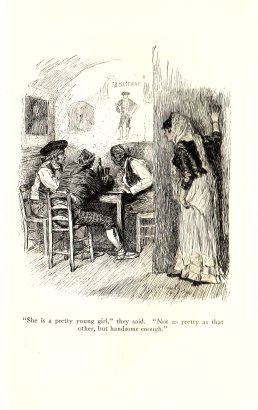
He could not know that where he had been she had been also; that when the snatches of song had been sung she had heard them; that when the people had talked of Sebastiano she had listened; that when Sebastiano had stood in the bright light she had stood in the shadow and watched. She had not thought of danger or of being discovered. She had only thought of one thing and listened for one thing-and once she had heard this thing discussed by some chattering young chulos.
"She is a pretty young girl," they said. "Not as pretty as that other, but handsome enough.
She was a little devil, that other. But it is a mistake for a man like him to marry. How can a man feel free to risk his life gayly when he has a woman hung about his neck?"
Pepita had leaned against the wall, putting her hand to her throat.
"He will not," she whispered, growing hot all over. "No, he has not forgotten. I have given the little heart and the flowers and candles. And he could not forget while I- He will come back."
She struggled with the passionate persistence of a child. Since she would not give him up, he was hers.
But she did not know what to do. There was nothing but to wait in this fever of strange misery and unrest, which grew more cruel every day; and at the bull-fight if he would only look -perhaps-yes, if he saw her face, he would understand and come.
In the days before the great entertainment took place she was like some little savage creature at bay. She could scarcely bear to hear the voices of those who spoke to her. Once she went into the church and threw herself upon her knees as usual, but when she looked up her eyes were fierce.
"If he does not come," she cried to the waxen Virgin, "I will pray to you no more-no more." She knew that it was blasphemy, but she did not care; and before she went home she bought a sharp little knife and hid it in her breast.
"This," she whispered, "this-if it is true about the girl from Lisbon; but it is not true."
For many years afterward the day of the great bull-fight was remembered. No one who saw it forgot it as long as he lived. Affairs used to date from it in the minds of many.
A year had passed since that first brilliant day when Pepita had gone forth in her first festal dress. She remembered it all as she dressed herself on this other morning. The same day seemed to have come again; the same sunshine and deep blue sky. There were the same flowers nodding their heads; Jovita was grumbling a little in her haste, just as she had done then; and in the looking-glass there was the same little figure in the bright attire the soft black hair, the red rose, the red mouth. As she looked, a sudden triumph made her radiant.
"I have not grown ugly," she said.
No, she had not grown ugly. She was too young and strong for that, and excitement had flushed her into new brilliance.
When she found herself seated among the fluttering fans of rainbow colors, that moment's glow of exultation left her. Strangely enough, she could not help thinking of the empty church and the waxen figure before which she had knelt, and then of the nights when she had stood watching by the wall, and then of the sharp little knife in her breast. And then came the clamor of the music and the grand entry of the moving stream of color and glitter dazzling her eyes. No; just at first she had not the power to look. Could it be she-Pepita-who felt dizzy and could not see? who could distinguish nothing in the splendid panorama of the triumphal march? And what clamor, what excitement there was on every side! "What bullsl What men!" they were saying about her.
Only she seemed, in the midst of all the loud voiced eagerness and delight, to sit alone, a cold little figure vaguely tormented by the gaiety and the voices and the color of fluttering fans and ribbons and costumes. The deep rose had fled from her face; she sat with her hands wrung on her knee and waited for one moment to come.
The great bull ran bellowing around the arena; little beribboned darts were flung at him and stuck in his shaggy shoulders; brilliant cloaks were flaunted in his face; taunting cries mocked him. He charged hither and thither in blind fury, scattering men and horses, who only returned again to the attack.
"It takes too long," communed Pepita. "It takes too long."
And then the voices began to call for Sebastiano. "Sebastiano! Sebastiano!" on every side -even the grand ladies and their cavaliers clapping their hands and calling also. The beauties in the high places were always ready to see him come, and to give him a welcome when he risked his life to amuse them.
He stepped forth in his rich dress and with his gallant bearing, a more beautiful and gay figure than ever, it seemed, the excited people thought. He had grown finer, Without doubt, they said. His face was a little pale, but that only made more beautiful his long dark eyes, under their dense, straight, black lashes. It was the women who said this, and who saw the richness of his dress, the colors of his devise, the close curl of his crisp hair, the grace of his movement. The men saw his superb limbs, his firm step, his quick glance, his bright sword.
"Come, little slayer of bulls," they shouted, "and show us what you would have taught the people of America."
And it appeared they were not to be disappointed in their expectation of sport. They saw that when he stood before the bull and made a little mocking bow of salute, he looked into its small, furious eyes with a smile, as it drew near -a bellowing black mass, snorting and throwing up the dust. It was as ready to begin as he. It rushed upon him, and he was gone. He played with it, led it on, defied it, eluded it. The flashing sword seemed to become a score of glittering blades; the people shouted-rose in their seats-leaned forward-laughed-mocked the bull-cried out praises of sword and man and beast-of each leap-each touch of the steel's point.
"He plays with it as if it were a little lamb," they cried. "Sebastiano! Sebastiano!"
Of what use to tell what must be seen in all its danger to be understood? The joy and exultation rose to fierce fever-heat, the cries swelled higher, faces flushed and eyes sparkled and flamed, while the brilliant figure darted, leaped, attacked, played with death as it had done scores of times before.
Only Pepita sat without color or applause only Pepita's fan was motionless amidst all the fluttering-though her breast moved up and down, and the throbbing in her side was like the beating of a hammer. She was speaking to herself, though her lips were closed; she was speaking to Sebastiano.
"He will look soon," she was saying. "He will look as he did that first day. My eyes will make him look. They will force him to it. Listen! it is Pepita whose eyes are on you. You must feel them. You have not forgotten. No. And it is Pepita-Pepita!"
All the strength of her body and soul she threw into her gaze-all the fire of her young wildly beating heart and throbbing pulses.
"You must hear!" she said. "Pepita! Pepita!"
And unconsciously she leaned forward so that her white face and great eyes, and the little black head with the rose burning in it: hair, stood out among the faces of those about her.
And he looked up and saw her, and their eves met; and without knowing she started to her feet.
No one knew, no one but herself saw! how it happened; even she did not understand until all was past. Their eyes met, as they had done on the day a year before. No, not as they had done then, but with a strange new look. Sebastiano started; the arena swam before him; there was a second-a fatal second in which he saw only a small face without color and the red rose which was the color of blood. 'Then there was a roar near him-a roar among the people -a wild shriek from the women. The bull was upon him; he made a misstep, and was caught, amid the shrieks and bellows, and flung inert far out upon the hoof-trodden dust with the blood pouring from his side.
"But," they said in the wine-shops at night, "when they took him up, though they thought him gasping in death, he had not lost himself; and as they carried him out they came upon a girl-the one who is called `the pretty sister of Jose'-her brother was taking her away. She looked like one dead three days; and Sebastiano -there is a man for you!-tore the devisa from his shoulder and dropped it at her feet; and she snatched it up-all wet with his blood-and thrust it in her breast, and dropped like a stone. It is said that he loved her, and she had a devil of a temper and treated him badly. He is a good fellow-her brother Jose-and wept like a child for Sebastiano, and had begged to be allowed to nurse him, and Sebastiano will have it so."
"I am strong as an ox," Jose had said, weeping. "I can watch like a dog. I want neither sleep nor food, it if comes to that; and once when one of my comrades fell from a scaffold I was the only one who could nurse him without killing him with the pain. He will tell you that I nursed him well, and was never tired."
"Let him stay," said Sebastiano.
In his struggle with death, which lasted so -long, it was always the large form and simple, anxious face of Jose he saw when he knew what passed around him, and even when the fever brought him delirious visions he was often ,vaguely conscious of his presence. For himself,he did not know whether he was to live or die; but one night he found out.
It was a beautiful night which came after a long day in which those about his bed had looked at him with pitying eyes, and at last a priest had come and absolved him of his sins, and left him with a solemn, kindly blessing, with a soul clear of stain and ready for paradise.
He had fallen asleep afterward, and had dreamed not of heaven but of earth, of a red rose in soft black hair, and of a passionate little face whose large eyes glowed upon him.
And suddenly he was wide awake, and found his dream a living truth.
Jose was no longer in the room. The moonlight made everything clear, and upon the floor beside him knelt Pepita, her eyes fixed upon his. "Dios! Dios!" he murmured.
"Hush!" she said. "Do not speak. It is Pepita. Look at me. They said that perhaps to-night you would die. I have prayed until I can pray no more, and when I came to Jose the tears were falling from his eves, and he said perhaps you would not see the day. Then I showed him the little knife hidden in my breast, and told him if he did not let me come to you alone I would not live. I said I could force you to remain on earth. I love you-I love you. It has all happened, that which you said would happen; and when the devisa fell at my feet I hid it in my breast with the other which was there before. And because I love you so, you cannot die. I will do anything you say I must do. I am Pepita, and I give myself to you. I would give my blood and my life and my soul for you. Every night I have waited by the wall in the hope that you would come. I have watched you when you did not see me. If you had not come I should have killed myself; if you die, I will drive the knife to its hilt in my heart. I can love more than those women who love so easily and so often. I knew nothing about it when I was so proud and mocked you. I know now. Mother of God! it is like a thousand deaths when one cannot see the face one wants. What hunger night and day!-one is driven mad by it!"
She bent more closely over him, crushing his unwounded hand against her heart-searching his soul with her look.They said there was a girl in Lison whom you loved," she said. II knew it was a lie."
"Yes," he whispered, "it was a lie. Kiss me on the mouth."
His arm curved itself around her neck, and the red lips which had mocked melted upon his own.
"Did you suffer?" he murmured.
She began to sob like a child, as she had sobbed at the feet of the Virgin.
"I told you that you would suffer! It was the same thing with me. Saints of Heaven! human beings cannot bear that long. I shall not die, and I will make you forget the pain. Stay with me, and let me see your eyes and touch your lips every hour, that I may know you are Pepita, and that you have given yourself to me."
"I will stay through all the day and night," she answered. "They cannot make me go away if I do not wish it. They always give me my way. I have always had it-the Virgin herself has given it to me."
It seemed this was true. In a few months from then the people who strolled in the Public Garden on Sunday looked at a beautiful young couple who walked together.
"There are two who are mad with love for each other," it was said. "Sebastiano and his wife. She is the one he threw his devisa to when he thought himself a dead man. They used to call her `the pretty sister of Jose.`
|
|