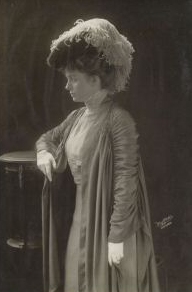
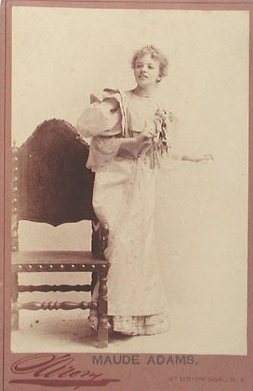
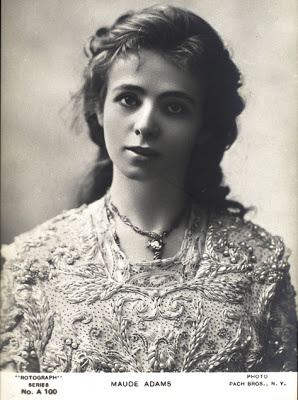
Great American Girls book entry on Maude Adams

Reaching up She Plucked a Star And Put It in Her Hair. Maude Adams. A Famous Actress.

Deep hidden among a mass of roadways and bypaths of Kensington Gardens, London, there stands a statue around which children play as if in the company of a beloved companion,-and,there too, at any hour of the day, older admirers may be found looking with interest at the dainty, elfish, roguish Peter Pan,-the children's Peter Pan,-the Peter Pan created by Sir James Barrie and Maude Adams.

The statue is of bronze, designed by Sir George Frayton, R.A.. in the same spirit of fantasy and elfin charm as prompted the writing and the acting of the part.

On a high rock stands Peter Pan, piping to the friends who gambol around him,-fairies, birds, rabbits, squirrels, crows and field mice.

Sir James often visited the Gardens. He knew where the children gathered daily to play, and there, on a wide expanse of emerald turf, he dreamed of seeing merry, mischievous Peter standing, forever to be the comrade of children who loved him so dearly,-who had so freely taken him to their hearts.

p>A sculptor was engaged to create the figure, with such understanding of the spirit of eternal Youth that he could breathe life into mere metal by the magic of his art, and then came Sir James Barrie's surprising command-one that took away the breath of both sculptor and Park authorities. The story goes that Peter Pan was to be placed in the park between darkness and dawn-a surprise to the children who the day before had seen only the broad expanse of greensward,-who in the morning would find their Peter standing on the very spot where he made his nightly landing in the Gardens. Their Peter, arrived as if by magic! Fairy tales and dreams come true!

It is said that there were objections raised,-it was declared to be an impossibility-Sir James was obdurate, and so one day wide-eyed, excited boys and girls found Peter there, a comrade who would never leave them-while they played in the shade Park, a merry Peter who would always be piping to the children of England.

Whimsical the character, whimsical the idea, and exquisitely whimsical artistically was the interpretation of it by Maude Adams, who would have won enduring fame from the one part had not so many other successes crowned her with laurels.

Maude Adams was the daughter of Annie Adams, an actress in a Salt Lake stock company and of James Kiskadden, a leading banker in that city. He came of an excellent Ohio family, and was a handsome and altogether delightful man, with such a magnetic personality that it was instantly recognized by anyone who met him.

When Maude was a baby her father was an object of her particular worship, and they were rare chums. Often he would be found sitting with her in his arms before the old-fashioned fireplace in their home. Sometimes he sang to her, or told her delightful stories, and always the comradeship between them was perfect.

James Kiskadden died when Maude was seven years old, and the world grew dark for Maude when the sad news came, of a loss that grew with the years. "With the passing of time she remembered him vaguely, handsome, debonair, and always her faithful ally. And under lock and key she has kept as sacred relics the few souvenir that remain of him, a faded photograph, a watch fob, a lock of hair, soft and auburn brown like her own."

He would have preferred not to have his only child on the stage, but when by chance she became a substitute baby when she was only nine months' old, the fatal step was taken and the world has profited by the mistake.

When Maude was born the Kiskaddens lived in a simple two story adobe house in Salt Lake City, where they were living when Maudie made her stage debut at the age of nine months!

Many times the story has been repeated, but it bears repetition. The stock company of which Mrs. Adams was a member, was playing "The Cottage Girl" a play in which Annie Adams was supporting a visiting star. The play was followed by a roaring one-act farce called "The Lost Child." Having no part in the farce, Mrs. Adams dressed to go home, but remained to watch the farce, in which a baby is rushed on and off the stage several times, and is finally arrived in on a platter by a waiter, and set before an astonished father, who has been frantically searching for his child who is supposed to be lost.

Mrs. Adams was standing by the call-board, much interested in watching the scene of the farce, which was almost over, when she saw her own baby being brought up the passageway to the stage door by her nurse, who had come to go home with Mrs. Adams.

Just as Mrs. Adams spied the pair, the stage baby "set up a howl," -not a howl which can easily be quieted, but one which meant a succession of shrieks ending in disaster to the farce.-The stage manager wrung his hands,-the cue for the entrance of the baby would come in a minute.-It would be impossible to produce a howling baby on a platter without ruining the farce. It has been said that the distracted manager, having caught sight of Maudie at the stage door, rushed to her, pushed her bewildered mother aside, snatched Maudie from the nurse's arms and laid her on the platter, just as the cue for the baby's entrance came. A moment later Maudie and the platter were in full view of the audience, who were convulsed with laughter which broke out afresh every few seconds. The howling infant who had made the first stage entrance was only six weeks old. Maudie Adams was nine months old-and had apparently gained about twenty pounds weight in five minutes. Good reason for an audience to laugh loud and long! The louder the laughter, the more pleased was Maudie, the new stage baby. Finally she became so enchanted with the lights and the laughter that she got on her hands and knees and cooed at the audience,-which naturally brought out a fresh storm of applause.

Maude Adams' stage debut was a huge success-and without any effort on her part to crate it, or any advertising of her ability or charms!

The other infant was dismissed from the cast and "Maudie" played the role of the baby as long as the farce ran. The incident is still recalled with great amusement by old inhabitants of Salt Lake City who are proud to claim her as their own at the time of her first stage appearance.

For the next few years she traveled in the west with the stock company of which her mother was a member, and a large part of her time was spent behind the scenes of the theatre, in fact she learned her letters in her mother's dressing room-while she was waiting, although she did not know it,-for the time to come when she would be a stage star, and not merely a back-stage daughter.

But besides her theatrical experiences, she had others of a really childish kind-among them many entrancing days spent at her grandmother's, where there were cows, sheep, dogs and horses to enjoy, for Maude Adams, both as a child and woman, has always been a lover of animals.

>When Maudie was five years old the Kiskaddens were living in San Francisco and Annie Adams was playing with J.K. Emmett. There was a child in one of their plays who was not satisfactory, and Mr. Emmett suggested that Maudie Adams take her place, and Mrs. Adams spoke to her husband about it.

Mr. Kiskadden's reply was quick and emphatic: "Most certainly not! She's my only daughter and I've no intention of letting her go on the stage and make a fool of herself."

Here Maudie, who had been listening eagerly to the conversation, laid down her knife and fork and said with equal decision:

"No, Papa; Maudie not make a fool of herself"-and the gleam of determination in her eyes settled the matter. In the following week Miss Maude Adams made her second stage appearance in "The Wandering Boys" wearing a pair of tiny knickerbockers, and playing the part of a small boy, Little Schneider.

There were nearly one hundred lines in her part but she memorized them in two days, and on the night of her first appearance said them without prompting or hesitation, and Mr. Emmett shook hands with the child and told her she was a good little actress.

Mrs. Adams told with great amusement of Maude's intense excitement on the opening night of the play, and how she directed her mother about making her up right, and how, after the rouge had been put on her cheeks and her eye-lashes darkened, she said very gravely:

"Muffer, are you sure I've got enough louge on?"

Having reassured her, Mrs. Adams hard her repeat her lines while waiting to go before the footlights, and she repeated them like a true actress, bringing out all the expression in them. There was one scene which worried her very much in anticipation, where she had to be tied to a water-wheel, and unless she screamed at a certain minute the effect of the whole scene would be spoiled.-Maudie was afraid she might ruin the play by a fatal mistake, and so was her mother, who stood in the wings watching her act. When the mill-wheel scene came and the critical minute was almost at hand, Maudie kept whispering to her mother:

"Muffer, must I scweam now?"

She screamed at the right moment and the part was played finely, to the intense satisfaction of actress and parent.

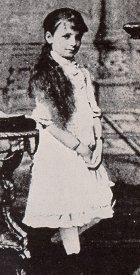
There is a photograph of Maudie at that time, taken in San Francisco, on the back of which is scrawled "For Papa from Maudie, nine years old."-still preserved among the treasures of one of her admirers.

Her next appearance on the stage was in "Fritz in Ireland" under Mr. Emmett, with whom her mother was playing, and she was such a success in the part that "Little Maudie's" name was printed on the program after that time, whenever she appeared, and it was by that name that she first became known to western audiences. A child's part in the play "A Celebrated Case" was the next role she played, and her scenes were mostly with Miss Belle Douglas, whose part in the play was a very important one. So afraid that Maudie would forget her lines, was the star, that she memorized them as well as her own, which made the child highly indignant and she exclaimed."

"You needn't fret about me; I'm all right."

After the play Miss Douglas laughingly told how Maudie kept whispering to her "Don't boffer about me. If you get stuck, I'll help you."

There was the promise of a real actress in Maudie, who soon dropped the childish name, and became Maude, but she always remained Adams instead of Kiskadden, although her father's family would have been glad to see Kiskadden on the programs when Maude became famous, even though they had not relished having an actress in the family when William Kiskadden married Annie Adams.

When she was less than six years old, Maudie-still the childish name,-played in "Out to Nurse." She was young enough to be daring when she objected to anything, and greatly disliked the cold tea which at that time was always served at every kind of supposed banquet, for whatever liquid refreshment was supposed to be part of the stage meal, whenever a dinner or supper party where wines or beer were supposedly served.

In one scene of "Out to Nurse" she had to carry a pitcher of beer on the stage to Mr. Murphy and others of the company who were on the stage, and drink a toast with them. In the pitcher was the cold tea of her detestation, and with the dignity and determination of a star of the company, she went to Mr. Murphy, who was both manager and actor, and told him she would give up the part unless she could carry real beer in the pitcher.

It is said that Mr. Murphy, who was very fond of the quaint child, was enormously amused at the demand and with a roar of laughter he patted her on the back and told her she should carry no more substitutes for beer, adding:

"That's the sort of leading lady I like to have! She wants real beer and she shall have real beer!"

After that the members of the cast were more than ever her friends, but Mrs. Adams never allowed Maudie herself to drink a drop of the beer which so cheered her stage comrades. But when they drank the toast they would wink at the little girl and add in a whisper: "'ere's to yer!'"

By reason of her successful appearances in child parts, "Maudie" became known as the most popular child actress of the Pacific Coast, and when she was about seven years old and the Kiskaddens were living in San Francisco, she attracted the attention of David Belasco, who at that time was stage manager of the Baldwin Theatre there, and he and James A. Herne were playing together. In many of their plays there was a child's part, and Mr. Belasco suggested Maudie Adams for these roles. He had known Annie Adams for some years, and thought her one of the outstanding character actresses of the west, and so had a natural interest in her daughter, whom he later said he remembered as "a spindle-legged little girl who was unusually tall and thin for her age, with a funny pig-tail and one of the quaintest faces you ever saw."-But, Mr. Belasco goes on to say "Even in her babyhood there was a magnetism about the child,-some traces even then of that wonderfully sweet and charming personality of later years."

The child, in short, was a born actress, she had temperament, she could act and grasp the meaning of a part long before she was able to read. He goes on to say:

"After she had begun to pay in our company, when we were beginning rehearsals of a new play, I would take her on my knee, and explain to her the meaning of the part she had to play. I can see her now," he adds, "with her little spindle legs almost touching the floor, her tiny face, none too clean perhaps, peering into mine, and those wise eyes of hers drinking in every word. I soon learned to know that it was no use to confine myself to a description of her own work; until I had told the whole story of the play to Maudie and treated her almost as seriously as if she were our leading star, she would pay no attention.-Once she realized that you were treating her seriously, there was nothing that that child would not try to do. But first, mind you, she had to know all about the play."

After the parts had been given out, Mrs. Adams would always learn Maudie's lines before she learned her own. Then, bit by bit, she would teach the child her part. She had a good memory and made what is called on the stage "a wonderfully quick study."

One of Maudie's biggest successes at that time was a "little Crystal" in a play called "Chums," which scored a big hit for the long-legged, fast-growing Maudie, whose part was the most vital one of the whole play. But manager and mother were quick to realize that the child was fast growing into girlhood and could no longer take such parts as she had been successful in before.

To a manager this was a distinct regret, for the child had been a source of income to him drawing crowds to see her childish impersonations. But to Annie Adams, the devoted, self-sacrificing mother, who had watched over the child constantly during performances and rehearsals to see that no harm came to her of any kind, who had spent many a long night making a new dress for Maudie, after acting in the evening performance, it must have been a happy release from responsibility to realize that the time had come for the girl to be placed in a good school where she would have a different environment than that of footlights and applauding audiences.

Maude Adams-now no longer the "Little Maudie" of programs, went to school in spite of her many objections to the decree, and her mother insisted on having her remain there at the Salt Lake Collegiate Institute for two years, where she was registered as Maude Kiskadden, which name she kept until she went back to the stage.

At school she showed exceptional brilliancy in dramatic recitations, and in elocution always had a 100 mark,-being a good scholar in other studies as well. She was tall, slender and delicate in appearance, but was seldom sick, and had always a charm of manner which was shy yet appealing, demure but full of reserve force Her friends were devoted to her, and her elocution teacher was so much impressed with her ability that after one especially good rendering of a bit of characterization, she went to Mrs. Adams and said:

"You simply must educate Maude for an elocution teacher. She has great ability along that line, and in time I feel sure she could earn as much salary as eighteen hundred or two thousand dollars a year!"

With a quiet smile Annie Adams, who felt she knew more about her daughter's real talent than the kindly teacher, thanked her,-and Maude did not become an elocution teacher!

While Maude was still at school, and almost fourteen years old, she was suddenly assailed by an overwhelming homesickness and longing for her mother and the stage. She could not bear school any longer. Seating herself at her desk, she carefully wrote a letter to her mother, which has been preserved. In it she said:

"It's no use my studying any more, mother,-in fact it's all nonsense unless I'm to go into literature or am to be a teacher. But I want to go on the stage again, so that I may be with you."

Underneath the plea Mrs. Adams sensed the longing which was real pain to the child, whose love for her and for the stage life was so much a part of her nature, and she let Maude leave school to be with her. But the older girl found stage life very different from that of her childish career. As "Little Maudie" she had been a popular small personage. Now she was only "Annie Adams' daughter," with no stage experience in adult work, and with no standing among professionals. She would have to begin again if she wanted to conquer the technique of stagecraft.

She begged her mother to use her influence to get her an engagement; Mrs. Adams' reply was:

"I can at best only get you some temporary part, my dear, and that as an extra. If you truly want to become an actress, you will have to become one by your own efforts and by hard work. No worthwhile actress was ever made in a night,"-and Maude Adams decided. However rough the road might be, she would travel on it to the gate of success.

Mrs. Adams never doubted for a moment that Maude was a born actress, but this she did not tell the girl, for she wanted to have her work hard to gain her end. And work hard she did!

She studied the classics, and modern languages, learned parts which she saw acted nightly, and watched being played, noting carefully every gesture and inflect ion of the actress taking the role. Her mother had already given her a good ground work in the technique of acting, and besides the work she was doing along other lines, there was not merely the necessity for patience-for waiting until she should have a chance to play a grown-up part.

At that time, both actors and actresses in the west were having many try-outs ending in failures,-members of the theatrical profession were having a hard time to exist, and as a result many of them turned, as always, to the Actor's Mecca, New York.

Annie Adams decided that she and Maude would go east and try their chance in the big city, too, and one day they arrived-full of hope and expectations which were soon to be dashed, for competition was great, and the glitter and glamour and night life of the city did not compensate for its hardships. Even finding a good place to live was none too easy, for what they could afford to pay, and it took many weary hours and days of looking before they were settled in fairly comfortable quarters near Union Square.

Then day after day they went in search of an engagement,-money was growing scarce and there seemed to be no hope of success. Maude would come in, disappointed and tearful, to be met by a bright smile which Annie Adams always had for her beloved child. Then she herself would go out to look for luck which might be hiding around the corner, and it would be. Maude whose smile warmed and cheered her when she came in, tired and disappointed,-but they never had the blues at the same time. And so days went by,-even Annie Adams' superb courage was beginning to wane-when one day the door opened and a radiant Maude came in,-her eyes bright with happiness: "I've got one!" she exclaimed" "I've got a part in The Paymaster,' the melodrama that is going to be put on at the Star Theatre. Isn't it wonderful?"-and mother and daughter rejoiced together.

During the early weeks of the run of The Paymaster, David Belasco, who had then begun his New York career, dropped in to see Duncan Harrison in the play. To his surprise he found a charming young actress, billed on the program as "Miss Maude Adams", playing a rather important role. He immediately recognized her as the "Little Maudie" of old days, and was deeply interested in watching her performance, not only because she was charming and excellently cast, but because she was the daughter of Annie Adams, for whom he had always had a great admiration, not only because of her character impersonations, but more especially because of her devotion to her daughter and the care with which she had brought Maude up.

As he watched the scenes of the play Mr. Belasco became more and more interested in the young girl's acting and realized that she had the making of a fine actress in her. Of one scene he said afterwards, with a chuckle: "In the scene Miss Adams had to be thrown into a tank of real water in order to be rescued by the hero. Maude was about as tall as her mother and looked very much like her. When I saw that tank scene coming along," said Mr. Belasco, "I said to myself,' "I'll bet you Annie Adams will never let Maudie jump into that tank.' And sure enough, when the climax came I, being up to all the tricks of the stage, saw that it was Mrs. Adams who took the plunge, not Maudie."

After the play, in talking with Mrs. Adams and Maude, he heard of the persistent cold which the young girl had had for weeks and could not shake off, which made it hard for her to act, so when it came to having her jump into that tank,-as Mrs. Adams explained:

"Of course it was I that took the plunge; do you think for an instant that I would allow Maudie to run such a risk and probably catch more cold? I was thankful I could do it for her."

During the entire run of that play, every day Maude Adams went to a florist's shop and bought fresh roses, which her part required-as she refused to use artificial ones,-just as the child had refused to carry cold tea on the stage for real beer!

Charles Frohman, as well as Mr. Belasco, saw Maude Adams in "The Paymaster," and his discerning eye also saw in her the making of a great actress. He decided to engage her for his new stock company which he was forming, but the company was not yet ready to open and meanwhile Mrs. Sothern, who had played with Maude, interested Mr. Sothern in her. "And," so Miss Adams has said, "he invited me out to dinner with them once, I remember. I couldn't speak I word, I was so diffident. I think he was disgusted, but afterwards he helped me.

And all the time Maude Adams was developing in charm, in ability to express what a role demanded, by the power of her many-sided talent.

Meanwhile, Charles Hoyt, having also seen her in "The Paymaster," decided that she would act the role of a young schoolmistress well in a play which he was going to put on at the Bijou, a play called "A Midnight Bell." The part was not an important one, but she managed to put into it such charm and individuality that soon everyone who saw it was asking others, "Have you seen the new little girl in Hoyt's play at the Bijou? She's sweet!.

That play was one of Charles Hoyt's big successes, and to many the most vivid memory of it is Maude Adams' portrayal of a small part. As has been said by a well-known theatrical critic of the day, "She had hit the theatrical bull's eye squarely and scored One."

A compilation, delightful but vexing, and when the play ended. Mr. Hoyt offered Maude Adams a five-year contract on her own terms, and Charles Frohman made her a less advantageous offer to play with his Stock Company.

An embarrassment of riches!

Maude did not hesitate long. She much preferred acting in serious drama than the farce comedies like "A Midnight Bell," and so she made what she did not know then was to be the most momentous decision of her life,-she signed a contract with Mr. Frohman, and remained under his management from that time until the day of his tragic death.

The Stock Company occupied Proctor's Twenty-third Street Theatre when it first opened, and with that company Maude Adams played a small part in a play by De Mill and David Belasco, called "Men and Women."

How little did either producer or actress dreamed on that opening night that the young actress from the West was knocking at the gates of that success for which she had been working,-that they were ready to fly open at her touch and lead into such a magic land of dreams-come-true that she would have been overcome had she glimpsed the future lying before her.

Although fully aware of her great ability, Mr. Frohman did not push Maude into prominent roles too soon,-in the DeMille-Belasco play she had a small part, as in Gilette's "All the Comforts of Home," and neither of them gave her a chance to show her ability even though in the latter she played opposite Henry Miller.

Mr. Frohman had been watching her closely, and her next role was one better fitted to her talent. As the lame girl in "The Lost Paradise," New York audiences came to know the delicate, heart-touching, indefinable thing known as the pathos of Maude Adams, and to love her for her subtle, sympathetic understanding.

She had been three years under the management of Mr. Frohman when he called her to his office one day and said casually:

"John Drew has left the Daly Company-he has been under that management for eighteen years, but next season he is to be my star. You are to be his leading lady."

Maude Adams gasped! John Drew's leading lady! Take the place so long occupied by Miss Ada Rehan!-could such things be? In telling of that day Maude Adams said "I had to clasp my knees to make sure I was really there."

When the news was circulated among stage and social circles there were many murmurs of disapproval.-She was so young, so inexperienced,-it was absurd,-impossible! She would be a failure.

On the third of October, 1892, "The Masked Ball," an adaptation from the French by Clyde Fitch, opened in New York at Wallack's Theatre. The premiere was a brilliant one, for all Jon Drew's loyal admirers were there to applaud him, under the new management.

His performance was a great success-it could be nothing else, with his record of brilliant achievement. And opposite him played young and inexperienced Maude Adams, the choice of whom, for the young wife's difficult and delicate role, had been so severely criticized. Was she a failure. The story is told in the fact that she had twelve curtain calls, and as much applause as John Drew himself received.

"Little Maudie" of the child roles had arrived as "Miss Maude Adams of New York!" Although naturally the greater praise was given to the star of the evening by newspapers the following day, one contained this paragraph:

"The great situation of the play does not fall to Mr. Drew's share; Miss Maude Adams, a young actress who until last evening had only been seen in minor roles, fairly shared her honors with Mr. Drew. her performance was a revelation."

In the part the young wife has to pretend to be drunk in order to punish her husband for some remarks he has made.-If the scene had not been done with the most delicate refinement and the greatest art it would have spoiled the act.-Maude Adams did it with a balance of dignity and feigned intoxication which captured her audience

When she was interviewed afterwards she confessed,"It wasn't easy to do-for really, you know, it is not at all like me, though I am fond of comedy. One of the old ladies of the Sothern Company said to me,'Why, whatever has gotten into you? You never used to take a drop with us,' and I told her I had gone to the demnition bow-wows and was tipsy every night now."

So skillfully did the young actress appear to be drunk and yet remain a gentlewoman at the same time that a reviewer says, "Miss Adams achieved this feat...so successfully that the applause lasted for fully two minutes after her exit." The scene stamped her as a comedy actress of a high grade, and her scenes of tenderness were equally delightful in their delicacy of feeling.

"The Masked Ball" was so successful that it was eighteen months before John Drew had to have a new play. Meanwhile Maude Adams had made her place in the hearts of the audiences who alternately cried and laughed at her will.

During the run of the play she was not merely acting, she was also working, and studying as she says: "Like an undergraduate at French, and learning to play on the harp." "I mean to introduce it in a play some time," and added: "Mr. De Mille said when I could play the harp he would write the scene. Oh, but I had a beautiful scene all dreamed out!-a young man looking love at me over the hollow place in the top,-the slope, you know. But when my teacher came he told me I was sitting at the wrong end of the harp and away went my scene."

She studied the Shakespeare plays, too, and many others,-in fact when not on the stage she was constantly reading ,making scenes and putting herself in various situations, for the sake of practice.

Her next play was a light comedy by Henry Guy Carleton, called "Butterflies," which added nothing to her honors, but in "The Bauble Shop" by Henry Arthur Jones, she was a tremendous success, and the play showed a widely different side of her talent than that showed in "The Masked Ball." She also did some clever work the next season in "That Imprudent Young Couple," but the play as a whole was a failure, being heavily scored by the cities, who, however, admitted that Maude Adams' acting "is still exceptional in its daintiness and its simplicity. Her work has grown in many ways during the past year. At present"-so said a critic,"Miss Adams is easily the most accomplished and womanly artist of all the younger actresses. She has found the short cut which leads from laughter to tears-"

The unsuccessful play was quickly changed to a comedy by Madeleine Lucette Ryley, called "Christopher,Jr." The merry little piece set all New York to laughing, and in it Maude Adams did one of the most artistic pieces of acting among the many to her credit.

By this time her bank account was so much larger than it had been for many years, that she was much better able to bear the failure of the next play in which she appeared, a play called in English, "The Squire of Dames," which gave Mr. Drew an excellent opportunity to show his talent to the best advantage,-and Maude Adams was good sport enough to rejoice that his part at least, was a success, even though she was mis-cast.

In the following September "Rosemary" was produced, and was an instant a complete triumph. Then suddenly Maude Adams' popularity grew to such proportions that it became a perfect furore, while Joh Andrew's success was also notable.

And now Charles Frohman, having communed with himself for some months on a certain matter, came to a decision. It was time to make Maude Adams a star. She was young, lovely, an idol of her audiences, who laughed or cried as she desired. She was ready for stardom!

At that time James M. Barrie was visiting in America, and Mr. Frohman had many long talks with him about making his novel "The Little Minister" into a play. For many weeks Mr. Barrie said he could not see a play in it, in spite of Mr. Frohman's assurances that he was wrong, but one day Mr. Barrie went to see "Rosemary." He sat through the first act, but after the second her hurried from the theatre to the manager's office. "Mr. Frohman," he was breathless as he declared it,-"I have found my Babbie!! I will write the play if I can have her for my heroine." Charles Frohman was delighted. The contract was signed-Mr. Barrie went back to England to write his play, and when it came to Frohman, he and Maude were enchanted with the manuscript, and at once Maude began to create the part as she saw it.

The play opened with a week of performances in Washington, then on a night in September, 1897, Maude Adams made her debut in New York as a star, at the Empire Theatre, with an expectant audience awaiting her.

What a welcome she received! Never could that ovation be forgotten by her, if she lived to be one hundred years old, or as one reporter of the day put it "if in time her repertory extends from Little Eva to Lady Macbeth."

The subtle, spiritual touch which James Barrie-now Sir James-gives to all his work, was strikingly evident in the play "The Little Minister," with its quaint, characters who represent all the prominent citizens of Thrums. The plot is a mere gossamer thread, but the play as a whole spells Romance exquisite, flawless of its kind.

It was a part after Maude Adams' heart. She threw herself into it with her whole soul, and so much akin to her own character was "Lady Babbie" that she was able to be the little devil who seemingly loves her lover less than she loves a joke, and yet in sudden glimpses show a Lady Babbie who is less flippant than she seems

There were critics of the play, of course,-many of them, but when all was said an done, it was realized that Mr. Frohman and Maude Adams had made fame and fortune. It was necessary for "Lady Babbie" to give performances in all parts of the country, after her run at the Empire ended, to satisfy a clamoring public which included, not only every kind of a theatre audience, but Sunday Schools and Clubs as well. To one who saw "Rosemary" and "The Bauble Shop," "The Little Minister" fell far below them in actual dramatic merit, but it was in that particular play that she scored her tremendous hit-having all sorts of children, as well as articles, named for her. One child in Connecticut is said to have had thirteen dolls, even one of them named Maude Adams!

Proud and happy must have been Annie Adams over the success of the daughter for whom she had cherished such high hopes, and in whose career she had not been disappointed.

Miss Adams was now in a position to own a home, and she bought a large estate on Long Island, where she could spend week-ends and indulge her fondness for fine horses and dogs. She kept one big St. Bernard in her New York apartment, and the faithful dog was her friend and protector at night, on the rug near the front door, barking furiously at any footstep other than that of his mistress; but when he heard her step he would simply look up and wag his tail in silent welcome.

At her luxurious country home, there were always plenty of saddle-horses. She also always rode horseback in or near the city, when she was playing or rehearsing a part. But naturally, after automobile came into use, she always had one, too, and has driven it herself whenever possible.

Her mechanical ability, which is great, was shown during the rehearsing of the play "Quality Street," in which she disliked the lighting of a certain scene. Most actresses would nave made life miserable for their manager until it was changed, but what did Maude Adams do? She just quietly went to the theatre one day earlier than usual, borrowed a pot of paint and a brush from a man who was painting scenery, and, as the story goes, unscrewed a few electric lamps from the footlights, and when the other actors and actresses arrived, they found her busily engaged in putting a coat of paint on the bulbs, which she though needed to be dimmed to make the light satisfactory.

There was a success of a certain kind for her in the role of Juliet, which she played in a manner quite different from the conventional one,-making Juliet a simple young girl with beauty and youthful charm. This gave a new significance to some of the love scenes, while on the other hand, critics of the old school to whom Juliet must be played in a certain way, were not pleased with her interpretation, but the play was a great financial success and Miss Adams came out of it without having lost any of her prestige in the world of theatre-goers.

"L'Aiglon" was her next role,-and although she played it to crowded houses for many weeks there were scenes in it which, in their very nature, did not belong to her temperament-scenes which only one or two actresses in the world would play, but which on their own momentum would have carried a far poorer actress than Miss Adams through to success. -When all is and done, "L'Aiglon" must be considered as the peak of her artistic triumph, by reason of some superb moments of interpretation, and as in all other plays which she ever attempted, she thoroughly grasped the underlying meaning of every gesture, every word in every scene, and so was able to play the difficult part so magnificently portrayed by Madame Sarah Bernhardt, who, even with her magic voice, superb acting and great name, had no greater success that Maude Adams which she played "L'Aiglon" in the west.

Miss Adams had become an idol of the English speaking people when she assayed the role in which many think she was her most flawless self, as well as a consummate actress-the role of Peter Pan.

Chosen for this difficult role by Sir James Barrie, because of her slender boyish appearance, her lightness on her feet, and her peculiarly childlike, elfish quality, she undertook the part with great enthusiasm, in fact became the embodiment of the Peter who was so dearly loved by all the children who adopted Peter as their own after once seeing him, and gave their mothers no peace until they had seen him again and sometimes three or four times.

The play was written in 1904 and produced in America by Maude Adams in the following year. To it flocked youngsters by the hundred, all caught up into fairy realms by the thrilling scenes in which, with Peter, they laughed or cried or watched the bold, alluring Pirate open-mouthed, as the moment demanded; fascinated but half frightened by him.

>Maude Adams kept the ideal of being children themselves constantly before her cast, requesting them to play the fairy play as they felt it themselves, or as they thought they would have felt it in childhood.

"I'm Youth, Eternal Youth!" cries Peter. He is a boy of the woods and of the wild flowers. "He has no mind to show us our cruelties, our follies, our greeds," says St. Gaudens in writing of Peter Pan. He adds, "This discovery of romance in every workaday object is brought forth anew by the woman whose every thought is filled with the upspringing heart of a true artist, which must always be the heart of youth."

Ushers at the performances of Peter Pan had their instructions to let children have their way, and in the recollection of the writer of this sketch there lingers the memory of a bright-eyed small boy, sliding down from his seat, walking slowly down the aisle until he stood right under the stage where, face upturned, he stood motionless, entranced, living in a fairy world with Peter, as scene after scene developed entrancing situations before his astonished eyes.

So much bewitched was another small boy by Peter's charms and his ingenious way of getting out of difficult situations that he determined to see his hero after the play and ask him a few questions. At the stage door he stood patiently, waiting for Peter to come out.-A woman!-She said shewas his hero! Never was Maude Adams more grieved than at having so disillusioned a dreamer of dreams. "Peter" never again left the theater after a matinee before making sure there were no little people waiting at the stage door!

Peter's mail was enormous-some of it amusing and some very touching-one small boy sent a request for "ten cents worth of fairy dust and full instructions for flying"; others told how the play had inspired them to paint pictures or to write the story of the play in their own words.-Others still, just wrote affectionate letters of intense admiration to Peter,-and from it all Maude Adams had the richest reward of all her stage experiences.

To play Peter Pan one must be Peter at heart, and with all her humor and her brilliant mentality, Maude Adams must have been a child among children when she so captured their fancy.

While playing the part, she bought a theatre car built at a cost of $30,000 to carry her company everywhere, large enough to enable them to rehearse en route to their next destination , for the roles needed constant rehearsing.

No part she ever played gave Miss Adams' peculiar qualities such a wide scope, and she loved Peter Pan best of all her impersonations.

In looking back to the days before Maude Adams left the stage and became interested in lighting effects, to which she has given serious study during the past few years-and also to color effects in stage work,-even seeing her in her Long Island home among her choice antiques, fine paintings and rare books-there is a still more charming recollection of her in the memory of one who once saw her at Ontario, where she appeared at a children's benefit dramatic performance and pulled the curtain for them,-having no name attached to her part of the performance. One who saw that simply, kindly act of a great actress, cannot fail to realize that Maude Adams will always be "Little Maudie," with a child's rich imagination and tender sympathies for every young person.

When a reporter in an interview with her once asked her various personal questions, Miss Adams replied:

"I have no theories and systems of exercise and dressing and bathing to interest people with, or rather, I have beautiful theories but I don't live up to them. I ride horseback and walk and am every so much stronger than I look"

"I haven't very decided opinions on the great questions of the day, but there's one thing I don't belie in ,and that is woman's rights...Any woman halfway clever can make the men do just as she wants to have them and at the same time keep them thinking they are having their own way...and what more would she have?"

Clever woman,-brilliant actress,-interesting woman, whose definition of genius is "the talent for seeing things straight."

But above the head of the actress and the woman I have a vision of the fairy boy, of Peter Pan, flying to Kensington Gardens in his swift nightly visit-I hear a cry, "I am Youth! Eternal Youth!"

"Little Maudie,"-"Maude Adams"="Lady Babbie," -but the greatest of these is Peter.